Before you begin
Starting knowledge
- Choose whether your role is learner, developer, researcher or application evaluator.
- For implementation, be prepared to learn basic programming and task-relevant mathematics.
- Begin in simulation; hardware access is optional at the first stage.
Equipment & environment
Write the task and starting skills first. Select one supported software stack, keep a versioned environment, and use the publisher documentation that matches it. The source comparison is a learning-design reference, not a claim that restricted courses are freely accessible.
No fixed completion time: use the evidence gates below to decide when to advance. Resource links open the botstest directory entry; check its publisher documentation for the exact version and configuration.
Beginner
Foundations and a reproducible first simulation
Explain a sensing–decision–action loop and reproduce a small project from a clean setup.
How this stage works
Use a small task to reveal which foundations you need next. Modern Robotics supplies the geometric model; the ROS 2 progression supplies software interfaces; the broad roadmap motivates projects and documentation. Our synthesis pairs each concept with evidence, instead of asking beginners to collect every tool. A simulator is the first experimental workspace, not proof that hardware will behave identically.
Work through an example
Illustrative study exercise · written by botstest
Illustrative exercise: move a simulated base or end effector to a known pose, then change the reference frame. Explain why the numerical command and observed position differ. No performance threshold or physical deployment is implied.
- Identify the task frame, robot frame and observed pose.
- Implement and inspect the transformation on a simple input.
- Run the simulation, log the result and compare it with the prediction.
- Break the frame or message configuration, diagnose the discrepancy and record the fix.
If progress depends on copying unexplained commands, reduce the task. Check units, frames, versions and the simplest input/output before adding perception or learning.
Reference basis: Robotics learning roadmap: a broad orientation; Modern Robotics: foundations through motion and control; ROS 2 tutorial progression — Jazzy. The example and walkthrough are editorial applications of the source.
- Define the task
- Check frames and inputs
- Run a simulation
- Reproduce and diagnose
| Skill | Practice evidence | Ready to continue |
|---|---|---|
| Programming and setup | A reproducible small program | Another person can run it |
| Geometry | A checked transformation | You explain units and frames |
| Interfaces | A recorded message/data loop | Missing input is diagnosed |
| Simulation | Expected and broken runs | Model limits are stated |
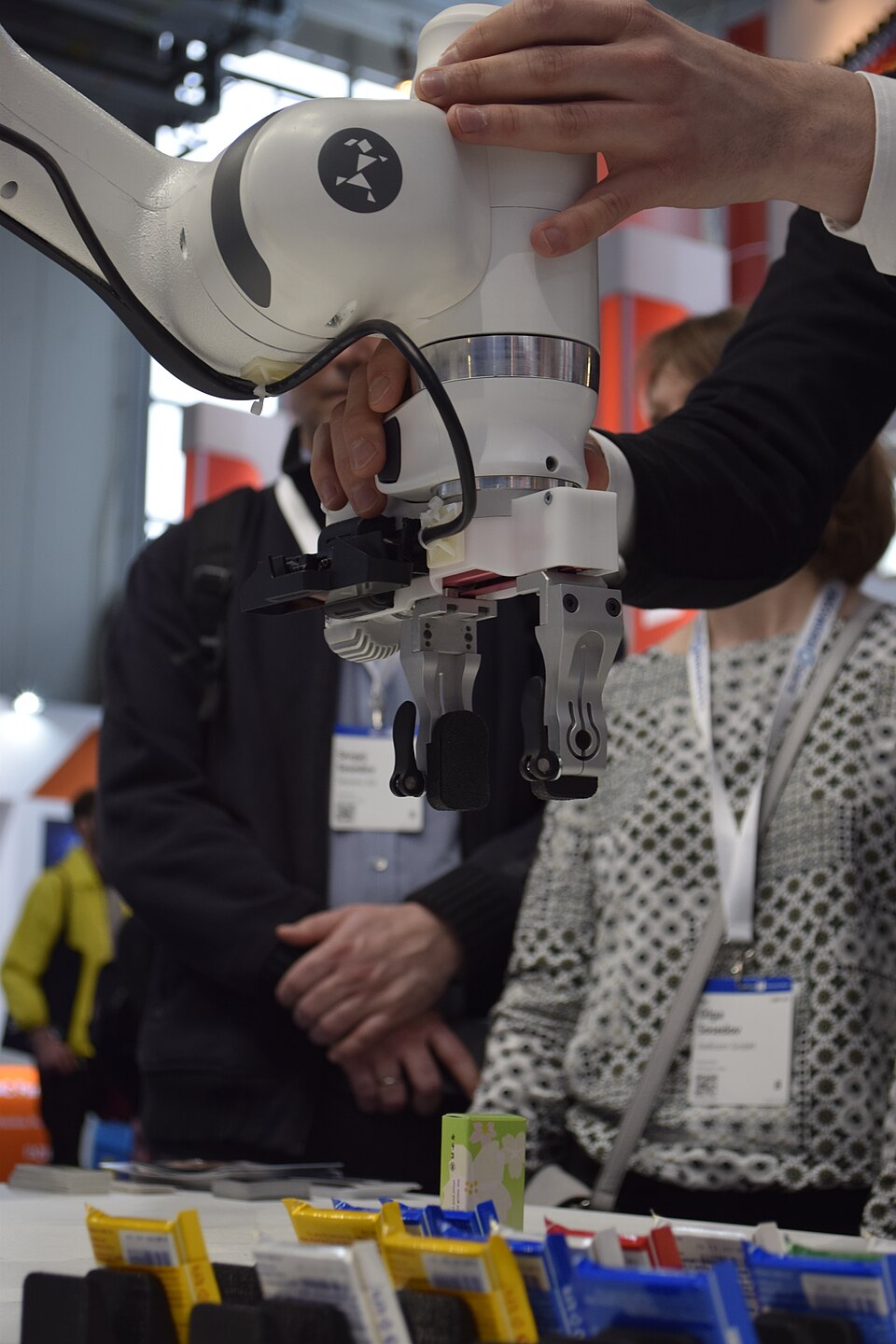
Reference teaching demonstration: a physical robot helps illustrate why models, interfaces and supervised practice must be distinguished.
Ims · Original source · CC BY-SA 4.0Learn in this order
- Write a bounded task: input, intended behavior, observable result and failure conditions.
- Use basic programming, files, version control and the mathematics required by the task.
- Study frames, transformations and simple kinematics alongside a simulated robot.
- Learn one supported middleware/simulator combination; keep its version and dependencies recorded.
Read, then apply
Coursera · Practical guide
Robotics learning roadmap: a broad orientation
Read: Build Strong Foundations; README Checklist; specialization table.
Foundations, practice, specialization and reproducible portfolios.
Apply it: Write a project goal and list evidence you will preserve.
Northwestern University / Lynch and Park · Course chapter
Modern Robotics: foundations through motion and control
Read: Configuration Space; Rigid-Body Motions; Forward and Inverse Kinematics.
An ordered mathematical foundation in configuration, rigid motion, kinematics, planning and control.
Apply it: Derive a simple transformation and check it against a numerical implementation.
ROS 2 documentation maintainers · Technical tutorial
ROS 2 tutorial progression — Jazzy
Read: Tutorials index on the Jazzy branch; follow the linked prerequisites.
The official sequence builds from first steps and beginner tools to client libraries, intermediate and advanced material.
Apply it: Create a small message pipeline and explain its nodes, interfaces and recorded observations.
Put it into practice
- Draw the data flow before implementing it.
- Build a simulated motion or sensor example, record an expected run and deliberately break one input.
- Ask another learner to follow the README and reproduce the result.
A versioned project with setup instructions, a data-flow sketch, expected output and a recorded failure/recovery.
Ready for the next step when…
Resources for this stage
Intermediate
Choose a branch and integrate a complete task
Combine the relevant skills into a tested navigation, manipulation, control or integration project.
How this stage works
The source sequences suggest different branches, not a single compulsory syllabus. ETH provides the mobile perception-to-navigation progression; MIT Manipulation ties geometry to object interaction; Stanford ties modeling to controller behavior; Fraunhofer shows practical modular integration. Choose the branch from your task. Buyers and operators can use the same structure to evaluate evidence without becoming robot developers.
Work through an example
Illustrative study exercise · written by botstest
Illustrative comparison: keep a navigation map and start/goal set fixed while changing one planner setting, or keep manipulation objects and poses fixed while changing one grasp strategy. Report failed attempts and interventions as well as successful runs.
- Choose the task, branch and measurable baseline.
- Define component interfaces and the test conditions.
- Execute repeated ordinary and failure cases.
- Change one factor, repeat and explain the limitations.
If adding components makes failures opaque, test each interface with recorded inputs. More advanced algorithms cannot repair inconsistent frames, poor data or an unrepeatable baseline.
Reference basis: Autonomous Mobile Robots: perception to navigation; Robotic Manipulation: perception, planning and control; CS223A: modeling, motion and force control; ROS 2 industrial training: from nodes to applications. The example and walkthrough are editorial applications of the source.
- Choose a task branch
- Establish a baseline
- Integrate and test
- Analyze failures
| Your goal | Primary branch | First complete project |
|---|---|---|
| Learning or teaching | Geometry and simulation | Reproducible demonstration |
| Mobile autonomy | Perception and navigation | Logged navigation task |
| Manipulation | Pose, grasp and motion | Bounded pick-and-place |
| Application evaluation | Requirements and evidence | Comparison and pilot plan |
| Home or maker use | Task fit and maintenance | Supervised bounded prototype |
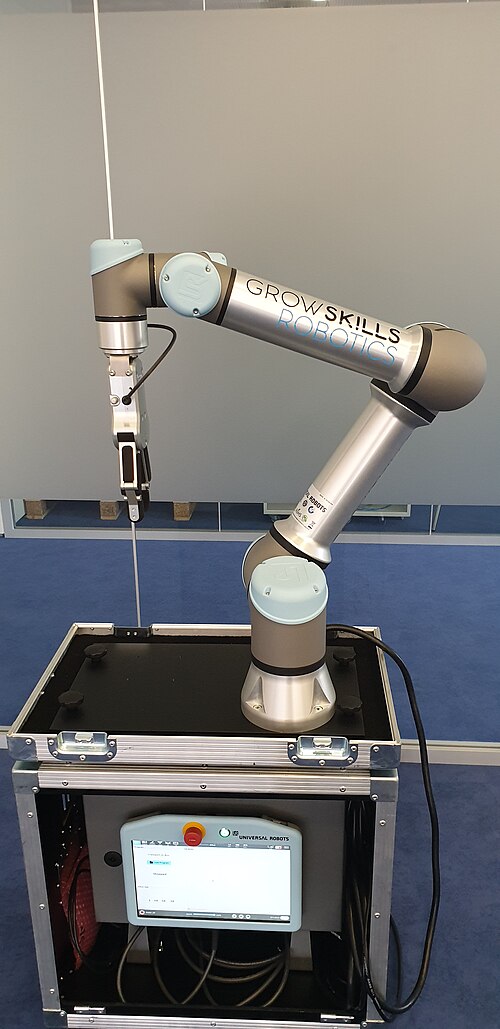
Reference robot photograph, not proof of a particular project or compatible component bundle.
GrowSkills Robotics · Original source · CC BY-SA 4.0Learn in this order
- For mobile robots: kinematics, perception, localization, mapping and planning.
- For manipulators: transforms, inverse kinematics, perception, trajectories and feedback.
- For control: dynamics and a baseline controller before advanced optimization or learning.
- For system integration: explicit interfaces, configuration, logs, failures and recovery.
Read, then apply
ETH Zurich · Course chapter
Autonomous Mobile Robots: perception to navigation
Read: Prerequisites; Optional Exercises; Schedule.
The archived sequence progresses from locomotion and kinematics to perception, localization, mapping and planning.
Apply it: Compare a localization estimate with a reference trajectory in simulation.
MIT / Russ Tedrake · Course chapter
Robotic Manipulation: perception, planning and control
Read: Organization; Basic Pick and Place; Geometric Pose Estimation.
Project-centered notes connect robot descriptions, pick-and-place, pose estimation and more advanced manipulation.
Apply it: Build a bounded pick-and-place example and classify failed cases.
Stanford University · Course chapter
CS223A: modeling, motion and force control
Read: Winter 2026 Expected Learning Outcomes and course topics.
The syllabus connects robot modeling, kinematics, dynamics and control to assessed outcomes.
Apply it: State an observable controller behavior and test model limitations.
Fraunhofer IPA · Practical guide
ROS 2 industrial training: from nodes to applications
Read: Session A: ROS 2 Basic and the published workshop structure.
The published workshop outline links ROS 2 concepts with practical modular application exercises.
Apply it: Document an interface, simulate a disconnected component and explain recovery.
Put it into practice
- Select one branch and define a baseline task and test set.
- Connect sensing, state estimation, planning and action only as needed.
- Test ordinary conditions, boundary cases and a failed dependency.
- Keep input data and configuration fixed when comparing changes.
An end-to-end project with a baseline, test cases, failure taxonomy and a clear operating boundary.
Ready for the next step when…
Resources for this stage
Professional
Validate, reproduce and specialize
Produce evidence that supports a research, engineering or adoption decision within a defined scope.
How this stage works
Professional here means depth of project evidence, not an accredited qualification. Underactuated Robotics offers advanced problem-driven tools; MIT Manipulation provides task-centered research context; the other sequences remain references for prerequisites. Our final gate is whether the evidence supports the claimed decision. A good simulated result is neither a safety assessment nor a production acceptance certificate.
Work through an example
Illustrative study exercise · written by botstest
Illustrative decision: compare a baseline and proposed method using the same task set. Preserve the denominators, interventions and environment. Decide whether the evidence justifies another experiment, a supervised pilot or no further investment.
- Freeze the task and evaluation protocol.
- Run and archive the baseline before the proposed change.
- Compare results, failures and required human work.
- Seek independent reproduction or qualified project review and record the next decision.
If a result cannot be reproduced, investigate hidden dependencies and selection bias before claiming progress. If physical testing changes the risk or scope, return to the appropriate local review.
Reference basis: Underactuated Robotics: problem-driven control and planning; Robotic Manipulation: perception, planning and control; Robotics learning roadmap: a broad orientation. The example and walkthrough are editorial applications of the source.
- Freeze the protocol
- Compare fairly
- Review and reproduce
- Decide the next step
| Gate | Evidence | Decision |
|---|---|---|
| Reproducibility | Code, data and configuration | Can another person repeat it? |
| Evaluation | Baseline and failed attempts | Does the claim match the measurements? |
| Physical scope | Qualified review and recovery plan | Is a supervised trial justified? |
| Operation | Owner, maintenance and support | Can the result be sustained? |
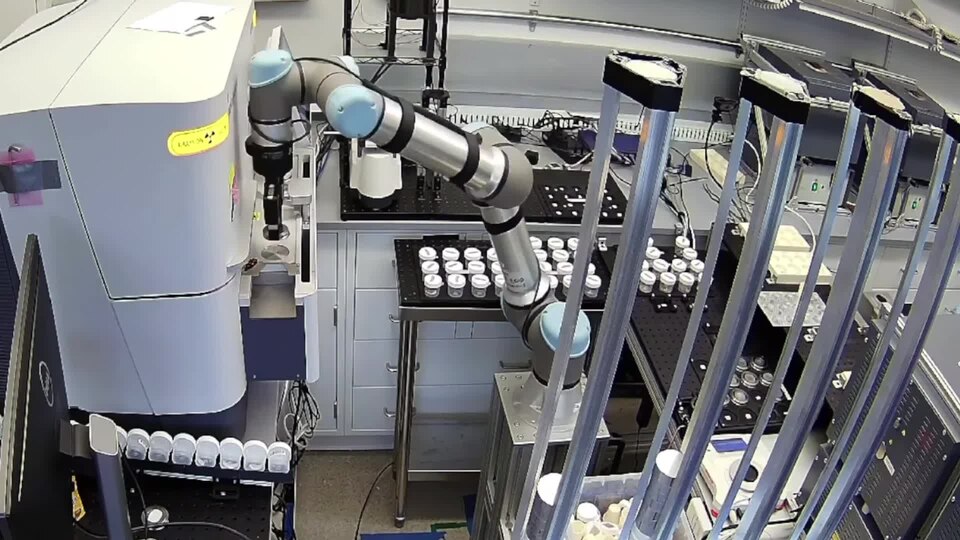
Published research-system preview: a reference for integrated experimentation, not independent reproduction or a turnkey educational package.
Nathan J. Szymanski; Bernardus Rendy; Yuxing Fei; Rishi E. Kumar; Tanjin He; David Milsted; Matthew J. McDermott; Max Gallant; Ekin Dogus Cubuk; Amil Merchant; Haegyeom Kim; Anubhav Jain; Christopher J. Bartel; Kristin Persson; Yan Zeng; Gerbrand Ceder · Original source · CC BY 4.0Learn in this order
- Use task-relevant advanced dynamics, optimization or learning after establishing a baseline.
- Control datasets, software/hardware versions, calibration and evaluation conditions.
- Separate simulation, research prototypes and site acceptance.
- Plan maintenance, access, recovery, ownership and a decision to continue or stop.
Read, then apply
MIT / Russ Tedrake · Course chapter
Underactuated Robotics: problem-driven control and planning
Read: Introduction and the dynamics, control and planning chapters relevant to the chosen task.
Dynamics and control problems motivate the mathematical tools needed for increasingly demanding robotic behaviors.
Apply it: Reproduce a baseline controller before attempting a learning-based improvement.
MIT / Russ Tedrake · Course chapter
Robotic Manipulation: perception, planning and control
Read: Organization; Basic Pick and Place; Geometric Pose Estimation.
Project-centered notes connect robot descriptions, pick-and-place, pose estimation and more advanced manipulation.
Apply it: Build a bounded pick-and-place example and classify failed cases.
Coursera · Practical guide
Robotics learning roadmap: a broad orientation
Read: Build Strong Foundations; README Checklist; specialization table.
Foundations, practice, specialization and reproducible portfolios.
Apply it: Write a project goal and list evidence you will preserve.
Put it into practice
- Reproduce an existing result or supported baseline and retain the evidence.
- Run a comparison with the same conditions and publish failed attempts.
- Have another person review and reproduce the project.
- For physical adoption, involve the qualified site/integration team before trials.
A reproducibility or pilot decision pack: task scope, baseline, methods, results, failures, limitations and next decision.
Ready for the next step when…
Resources for this stage
Common pitfalls
- Treating a list of technologies as a learning sequence.
- Mixing obsolete software instructions with another distribution or simulator.
- Skipping a reproducible baseline before adopting learning-based methods.
- Reporting only successful demonstrations or treating a research score as site acceptance.
Where to go next
Choose the scenario roadmap in Learning, Research, Development, Industry, Field or Home that matches your task. Reuse this foundation and evidence checklist, then follow the scenario-specific resources and readiness checks.
Explore other learn paths →