Wipe a long countertop and you’ll probably take a step to the side without lifting your hand or turning away. A robot that drives like a car has to work harder to make that same adjustment. The researchers behind TidyBot++ tried both ways of moving on the very same robot, then measured how far its base had to travel.
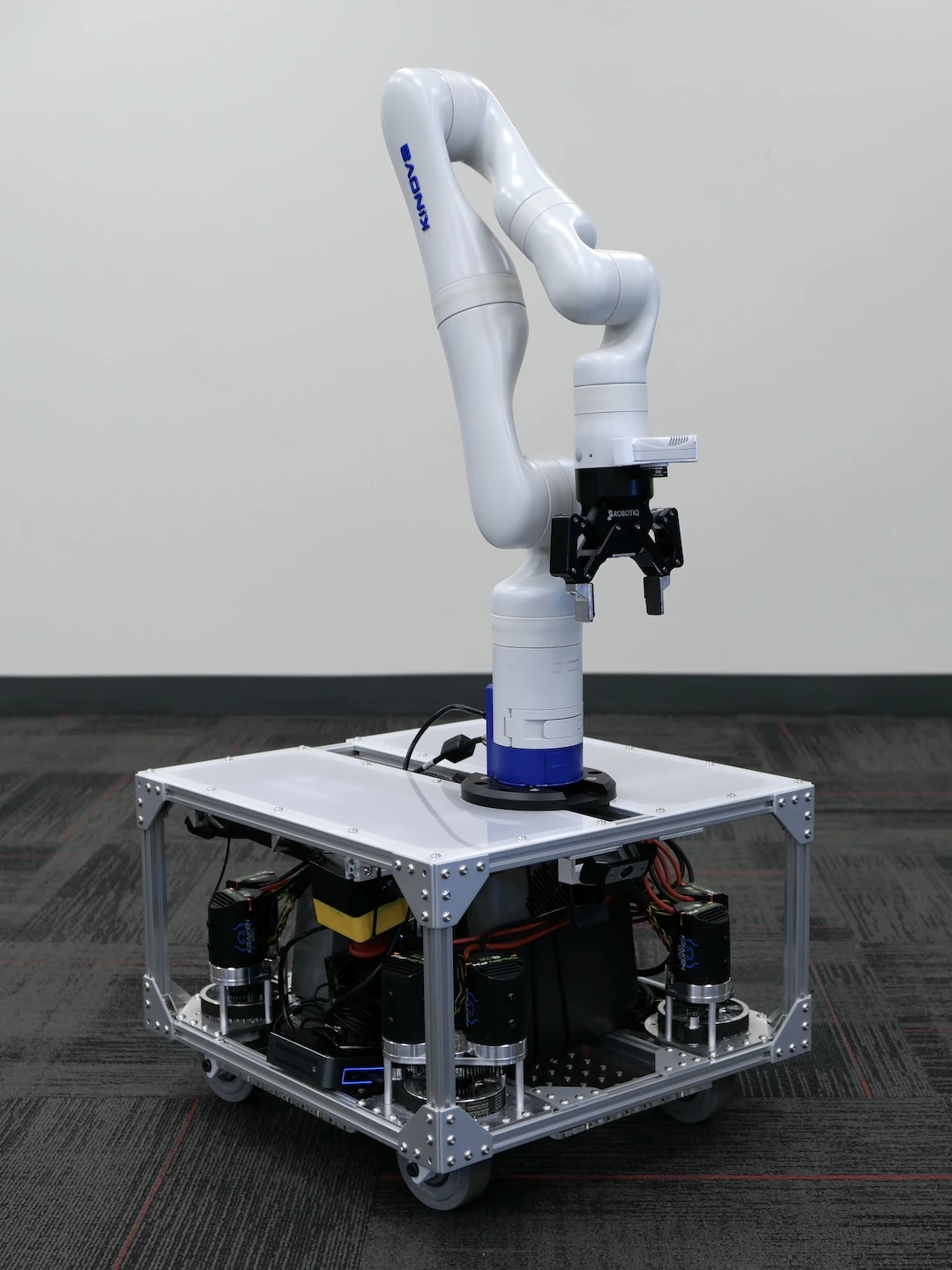
Build documentation photo, not a frame from the experiment. TidyBot++ in its Kinova-arm configuration. Photo: Jimmy Wu / TidyBot++ Docs, original, CC BY 4.0.

An office-chair idea, with motors
Jimmy Wu and collaborators affiliated with Princeton University, Stanford University and Dexterity developed TidyBot++ to study mobile manipulation. The authors show the robot doing household tasks in a real apartment. They don’t specify the location or filming date for the two-mode wiping comparison below. The preprint was submitted on December 11, 2024.
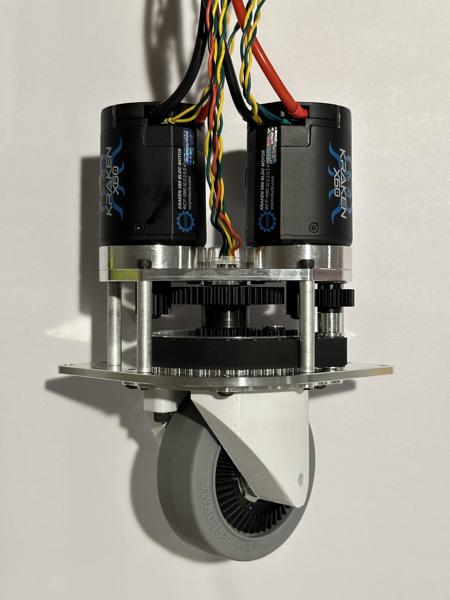
Look under an office chair. The wheel’s rolling axle sits off to one side of the vertical axis it swivels around. That little offset lets the wheel follow as you push the chair. TidyBot++ uses four powered casters with an offset too. Motors control both the steering and the rolling. The base can move forward, slide sideways, or turn, with direct control over each motion. So the chassis can keep facing the counter as the arm moves along the work surface.
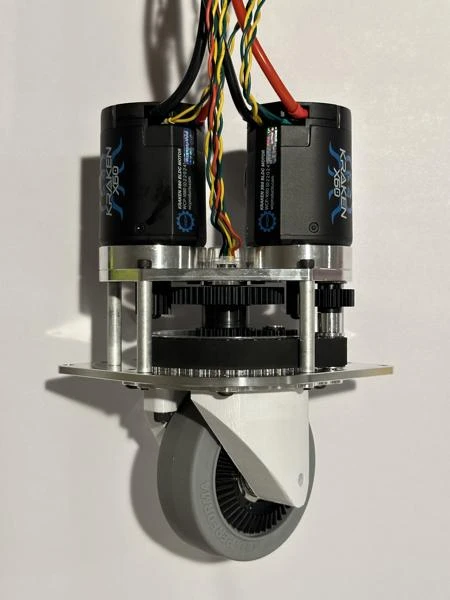
Build documentation detail: A powered caster from the assembly guide. The swivel axis and rolling axle are offset. Photo: Jimmy Wu / TidyBot++ Docs, original, CC BY 4.0.
Same robot, two ways of driving
For the countertop comparison, the team used the same physical base. In one mode, the base could slide sideways. In the other, software imposed the limits of differential drive, so it had to change heading to move across the floor. During the human-operated demonstrations, the base traveled 2.03 metres on average in the unrestricted mode and 4.03 metres in the constrained mode. Those figures come from the authors’ records in section 4.2; they aren’t estimates taken from the sped-up clips.
The useful question when designing a robot for narrow work surfaces: how much extra motion does the base make the arm put up with? In this setup, being able to step sideways shortened the route for one job. It doesn’t tell us which drive is better on every floor or for every chore, and BotsTest did not independently repeat the experiment.
Watch the authors’ two-mode demonstration · Paper: Section 4.2 and Figure 5 · Caster assembly guide · BotsTest resource
Turn the shortlist into a decision
Write down the task, operating conditions, success criteria and total ownership costs. Ask shortlisted suppliers to demonstrate your representative task, including failure recovery. Use the same acceptance test for each candidate.
Explore the full robotics directory →