Getting up from the floor sounds like a small assignment until the student is a humanoid. Fourier’s research team trained its GR-2 to tackle that motion in NVIDIA Isaac Gym, then reported transferring the resulting control actions to physical GR-2 hardware. NVIDIA and Fourier described the work on November 6, 2024. That is the report date; it does not identify the hardware trial’s date or location.
To reduce repeated practice on the physical machine, the team used reinforcement learning to rehearse under different simulated height conditions before moving the learned action outputs to the real controller. It reported about 3,000 training iterations in about 15 hours. Those numbers describe work in simulation, not 3,000 get-ups by the physical robot.
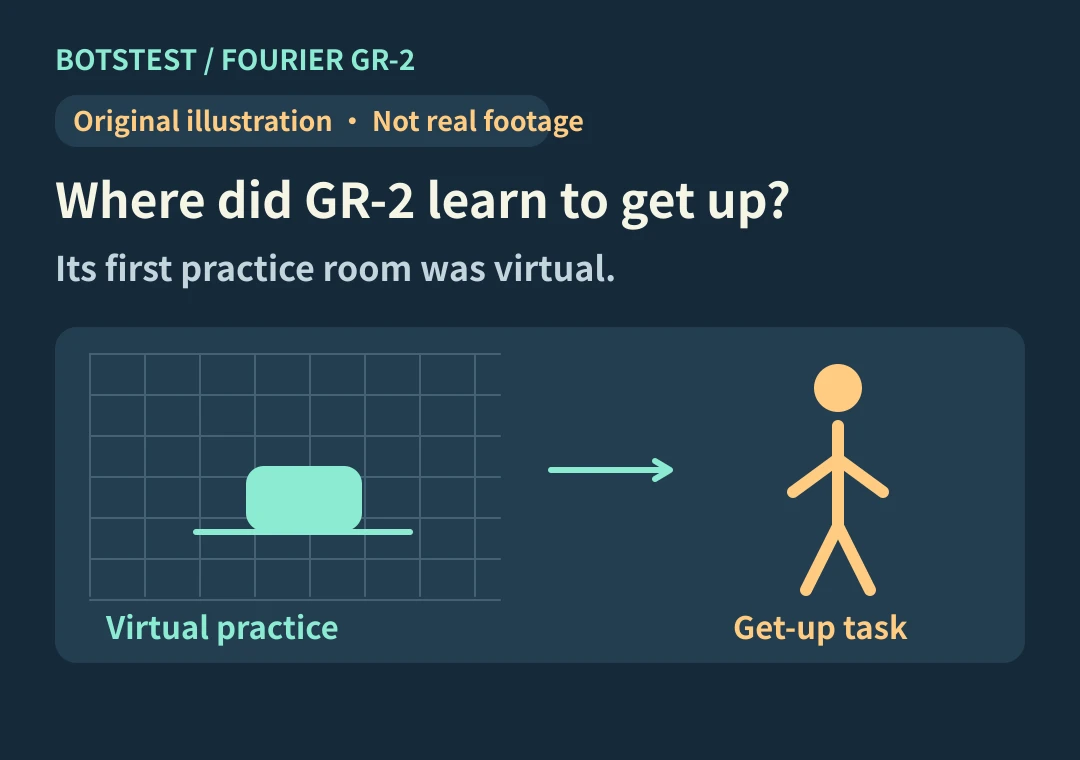
Original BotsTest illustration, not footage of a hardware experiment.
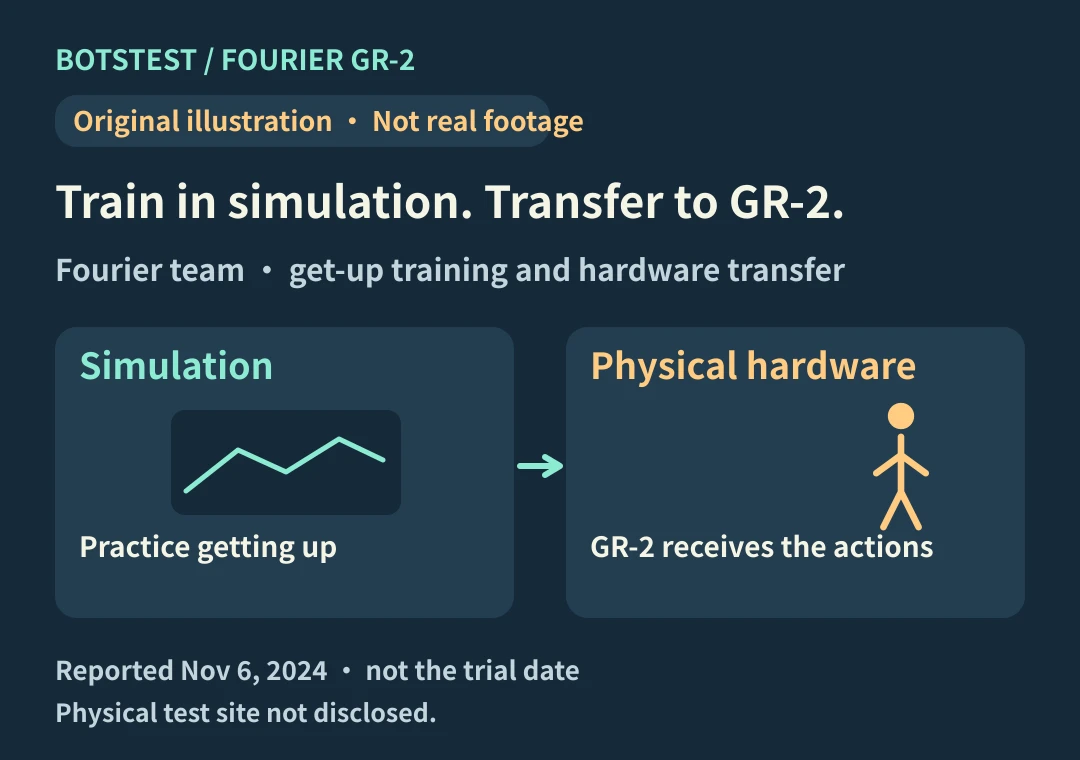
Fourier reports action transfer to physical GR-2 hardware. This is not footage of a hardware experiment.
What actually crossed over?
The virtual environment gave the training process a place to repeat the same problem under different conditions. What went to the physical system was not a replay of those training iterations. It was a set of control actions from the learned policy. That handoff, rather than the simulation count, is the result reported here.
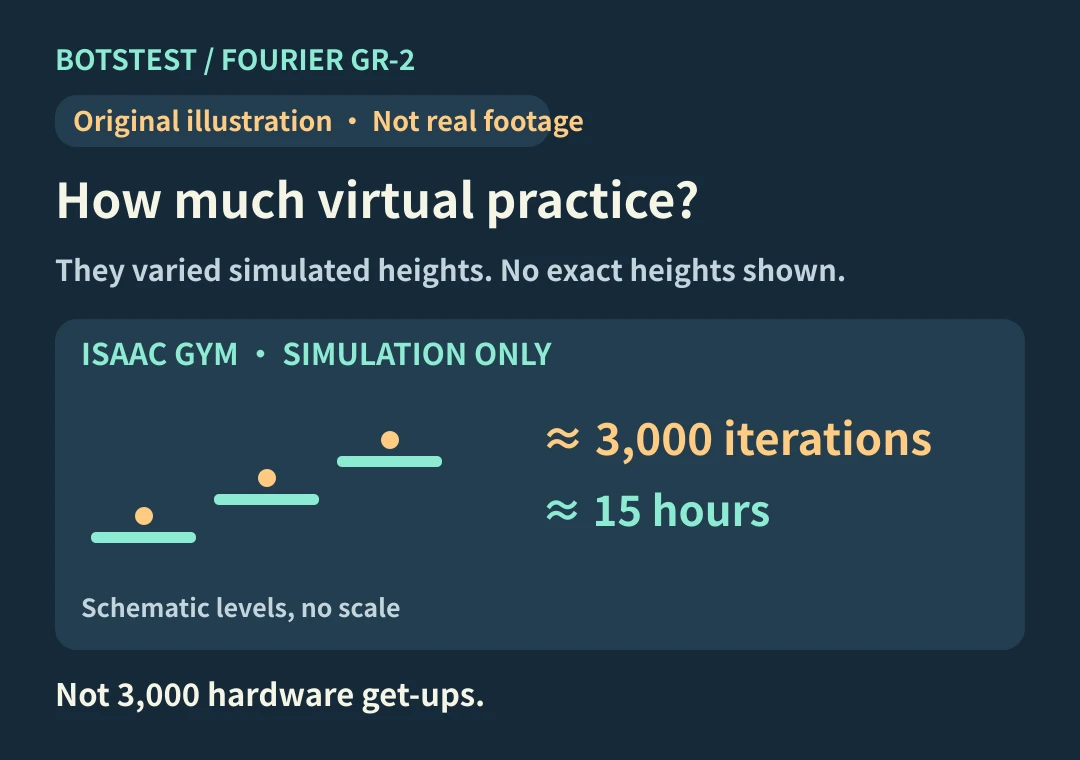
The reported iteration count and elapsed time both refer to simulation training.
Our drawings distinguish variable simulated heights from an undisclosed hardware test setup. The arrows show the flow of learned actions, not a published joint trajectory. The account does not settle how often the physical robot would get up from an arbitrary fall, whether it detects falls automatically, or how it performs on a particular floor.
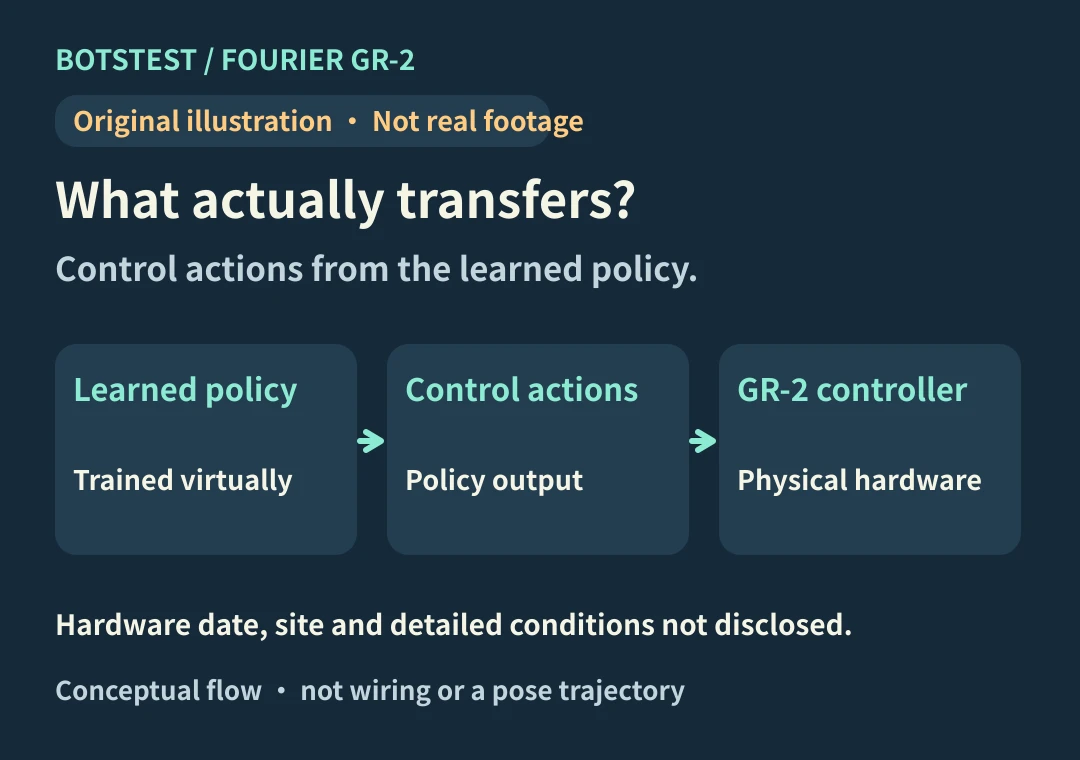
The arrow shows the conceptual handoff, not a documented joint-by-joint trajectory or trial protocol.
The takeaway: rehearse the motion in a world you can reset, then see whether those actions can drive a robot you cannot.
Primary sources: NVIDIA and Fourier’s report · Fourier’s GR-2 documentation
Visuals: original BotsTest illustrations, not real footage or a BotsTest trial. For rights or attribution concerns, please provide the link and supporting details through this platform’s available contact or rights-reporting channel. We’ll review and correct, replace, or remove the material as appropriate.
Turn the shortlist into a decision
Write down the task, operating conditions, success criteria and total ownership costs. Ask shortlisted suppliers to demonstrate your representative task, including failure recovery. Use the same acceptance test for each candidate.
Explore the full robotics directory →