The humanoid put the metal down and let another robot take over. In 2025, Figure AI and BMW’s production team deployed Figure 02 on an active line in the body shop at BMW Group Plant Spartanburg, South Carolina. The companies reported more than 90,000 parts loaded, supporting production of more than 30,000 BMW X3s. Figure published its results on November 19, 2025; that wasn’t the deployment start date.
To test repeatable part handling without changing who did the welding, the teams gave Figure 02 the job of picking up sheet metal and positioning it in a fixture; separate six-axis industrial robots welded the parts afterward.
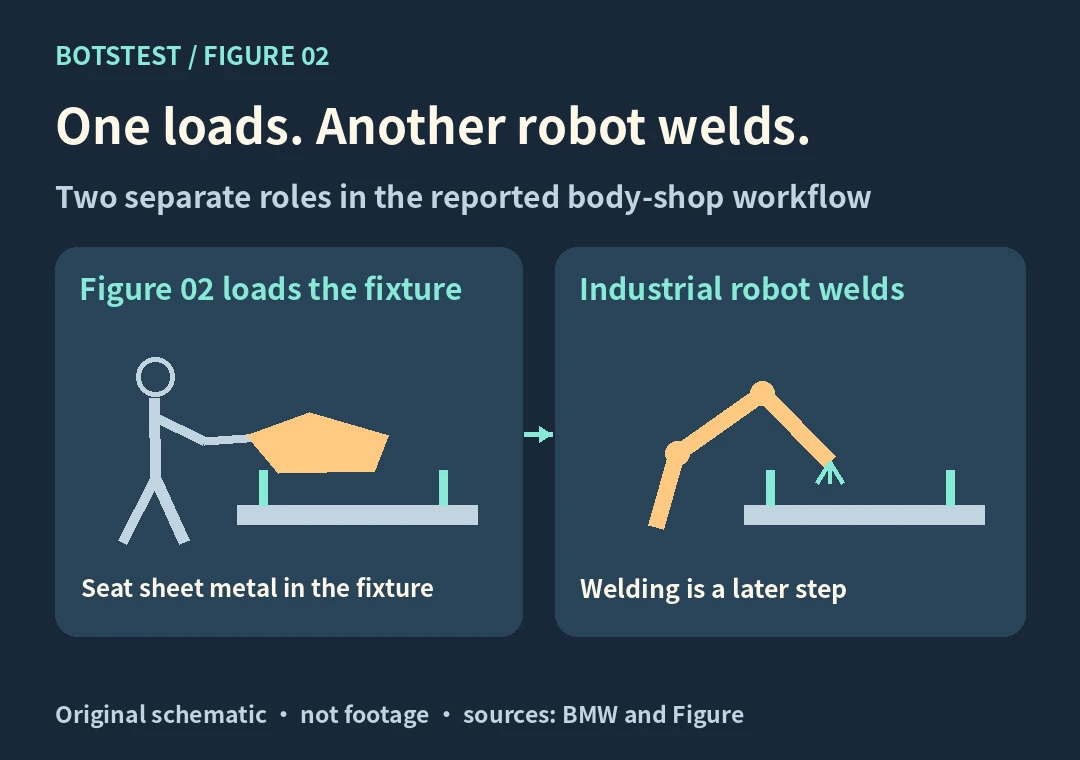
BotsTest schematic, not a factory photo or a reconstruction of the exact workcell.
The fixture is the handoff
The humanoid took parts from racks or bins. Its job was to get them into the right positions in the fixture, not simply to carry them across the floor. Figure says it developed hand-eye coordination and field-calibration tools for that work. The company describes a 5 mm placement tolerance as part of the design challenge, not an error it measured across the deployment.
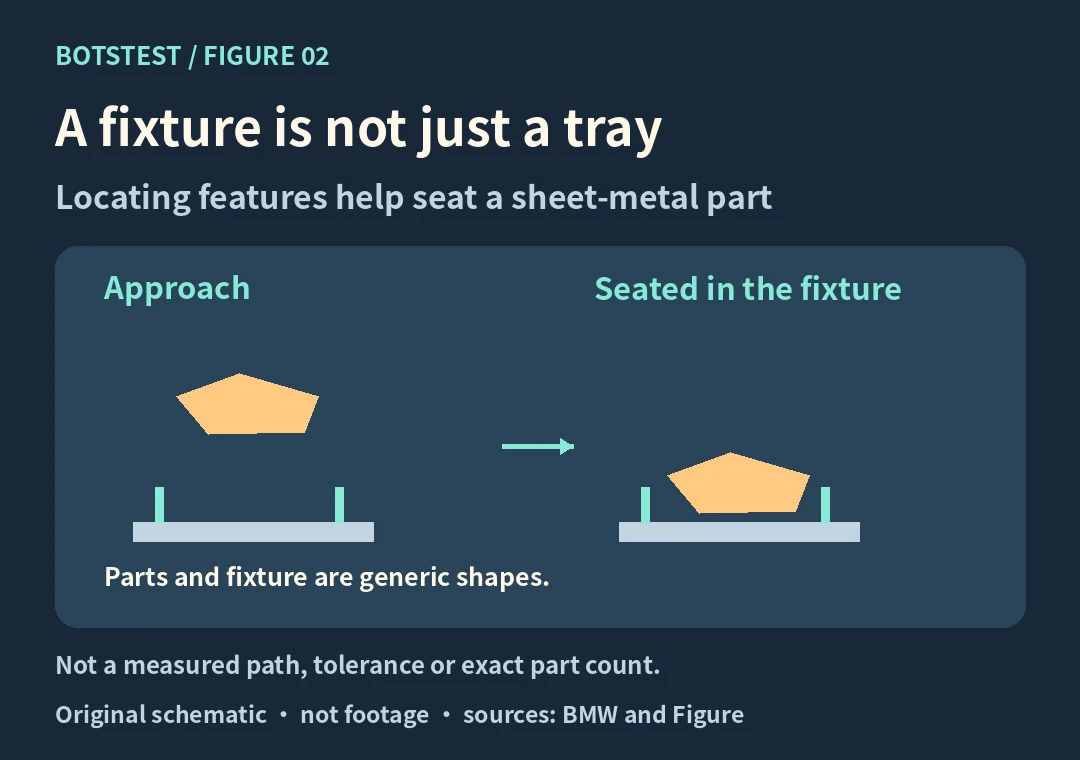
BotsTest illustration, not a measured trajectory or exact part geometry or tolerance.
Read the two totals separately
The parts count describes loading. The vehicle count describes BMW X3 production that the robot helped support. Neither is a pass rate or a claim that Figure 02 built whole cars. What it did was narrower: get the next pieces into place so the welding station could take over.
Sources: Figure’s November 19, 2025 deployment report and BMW Group’s recap, Spartanburg section.
Turn the shortlist into a decision
Write down the task, operating conditions, success criteria and total ownership costs. Ask shortlisted suppliers to demonstrate your representative task, including failure recovery. Use the same acceptance test for each candidate.
Explore the full robotics directory →