A finger can touch a page without being able to lift it on its own. The challenge is to turn one sheet without taking the next one along. Dantong Niu, Zhuoyang Liu, Zekai Wang and their coauthors tested that problem with a dual-arm Dexmate Vega-1 equipped with Sharpa Wave hands. On an indoor workbench, the full T-Rex policy averaged 96 out of 100 points on the page-turning task. The version without tactile input averaged 76. Those are scores that include partial credit, not the percentages of attempts that finished the turn.
The robot’s wheels, torso and head joints stayed fixed. Its right index finger had to lift a sheet on the right side of an open book, carry it across the spine and flatten it on the left. The preprint went public on June 15, 2026, and the authors revised it on June 18. The paper does not give the exact date or site of the experiment.
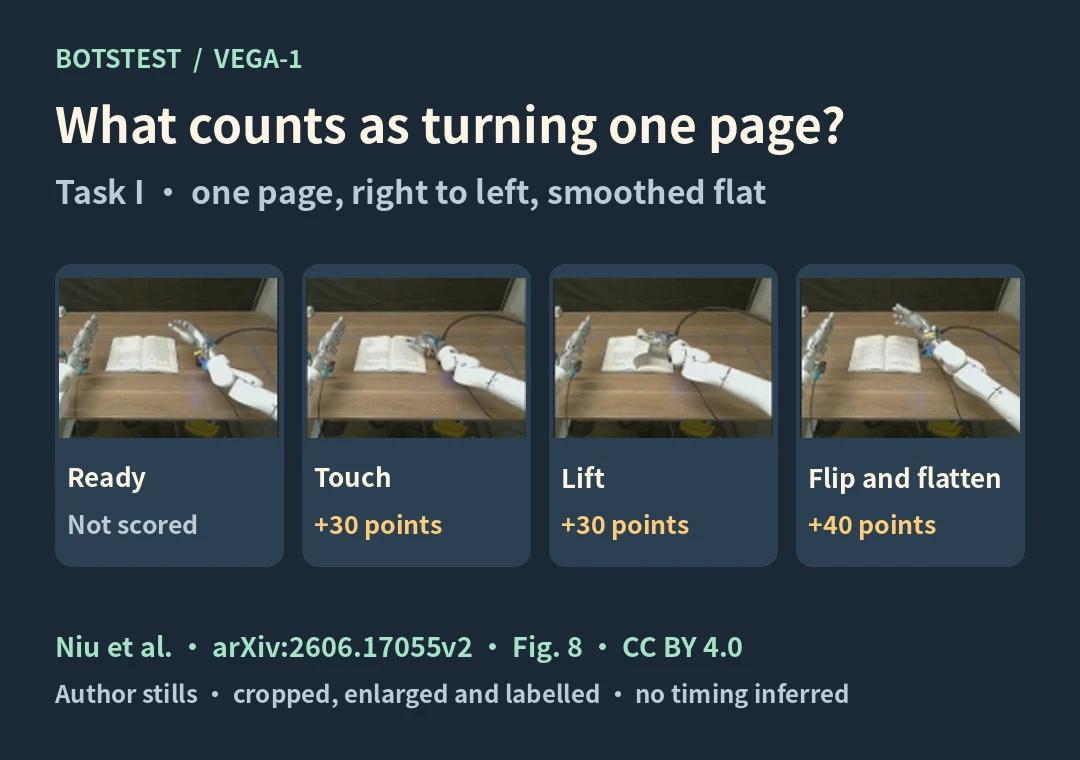
The authors’ example stages, not the full trial set or a measured motion trace. Dantong Niu, Zhuoyang Liu, Zekai Wang and coauthors, T-Rex: Tactile-Reactive Dexterous Manipulation, Figure 8, CC BY 4.0. Figure extracted and localized labels added.

Vision gets the finger there; touch helps adjust it
A camera can locate the book. Once the fingertip meets the paper, the robot has another source of information: forces at the fingertip and changes in shape at the contact surface. T-Rex uses visual information to plan the larger motion and uses those tactile signals on a faster loop to refine it. The authors compared that whole system against a variant without any tactile inputs. It was a comparison within this experiment, not a contest between two robot models.
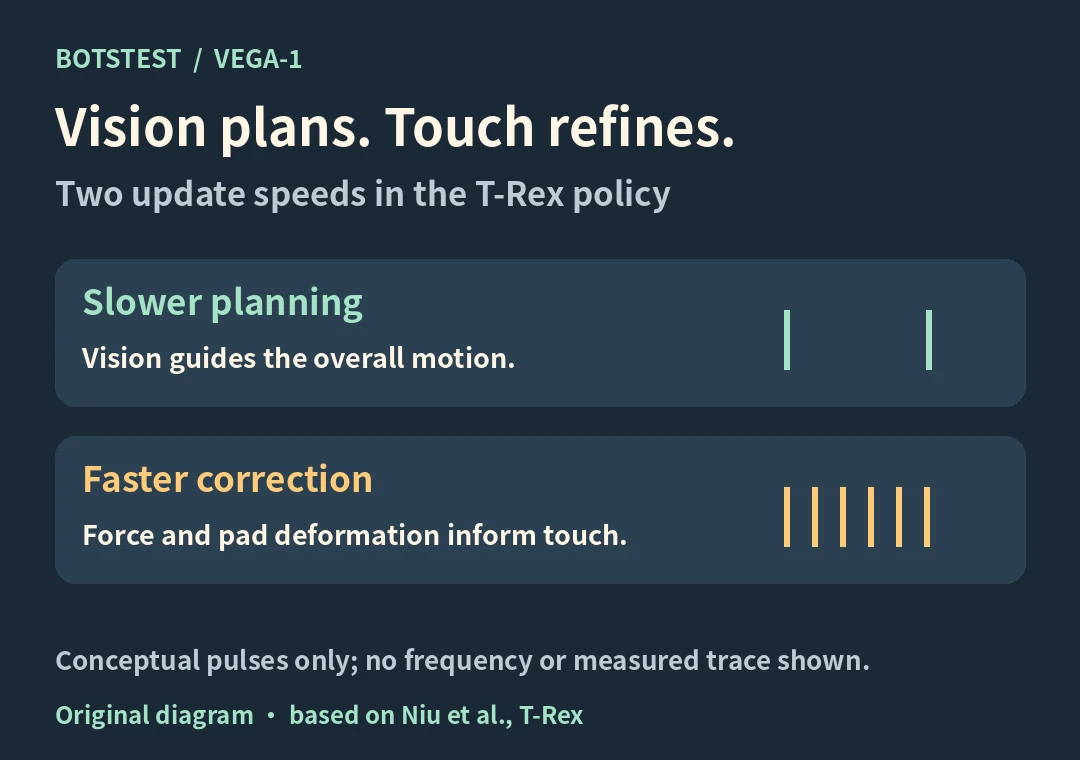
BotsTest schematic of the two kinds of information available to T-Rex. It shows neither measured forces nor the trajectory of a trial.
What got the points?
The authors awarded 30 points for touching the page with one finger, 30 for lifting it with the index finger, and 40 for turning exactly one page from right to left and smoothing it flat. A robot could earn points without finishing. The paper describes 16 trials per task, randomizing object position and orientation between trials. The 20-point difference tells us the version with touch did better on this rubric; it does not say how many attempts finished or which stage gained the most from touch.
This is evidence about one skill on this setup, not a guarantee with different books or a measure of general dexterity. BotsTest did not rerun the test.
Paper, §4, Table 2 and Appendices D and F · Version history · Authors’ project and videos
Turn the shortlist into a decision
Write down the task, operating conditions, success criteria and total ownership costs. Ask shortlisted suppliers to demonstrate your representative task, including failure recovery. Use the same acceptance test for each candidate.
Explore the full robotics directory →