The blue robot arm in this lab isn’t stretching to reach the furnace. Its entire base is sliding towards it. If you’ve ever rolled an office chair to reach a drawer instead of leaning across the desk, you already know the trick: sometimes it helps to move where you’re reaching from.
Watch the base, not the gripper
In the A-Lab authors’ footage, the blue UR5e carriage travels along a straight rail towards an open box furnace. The still catches it near the furnace; the motion is visible in the surrounding seconds. The image is useful for seeing the layout, but it doesn’t show when the gripper made contact or prove that a crucible was inserted in this pass. The source plays at 20× speed, so don’t use it to estimate how long the trip takes.
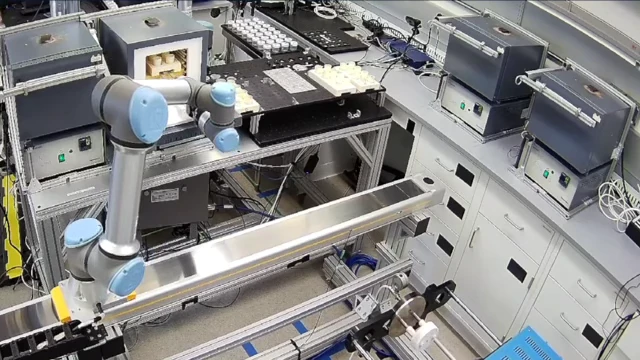
A-Lab authors’ footage, 20× time-lapse. Unmodified still extracted at 77.7 s from Szymanski et al., Nature (2023), Supplementary Video 2. The frame shows the carriage near an open furnace, not crucible insertion. Source file · CC BY 4.0.
One arm, more places to stand
Szymanski and colleagues identify this arm as R2 in Supplementary Video 2. They describe it ferrying crucibles from the sample-preparation station to box furnaces. Extended Data Fig. 2d shows the linear rail used to increase the arm’s working envelope: the set of places it can reach. The arm doesn’t get longer. The rail gives it more starting positions, each with its own reachable area. Put those areas together and one arm can serve stations that a single fixed base might not reach.
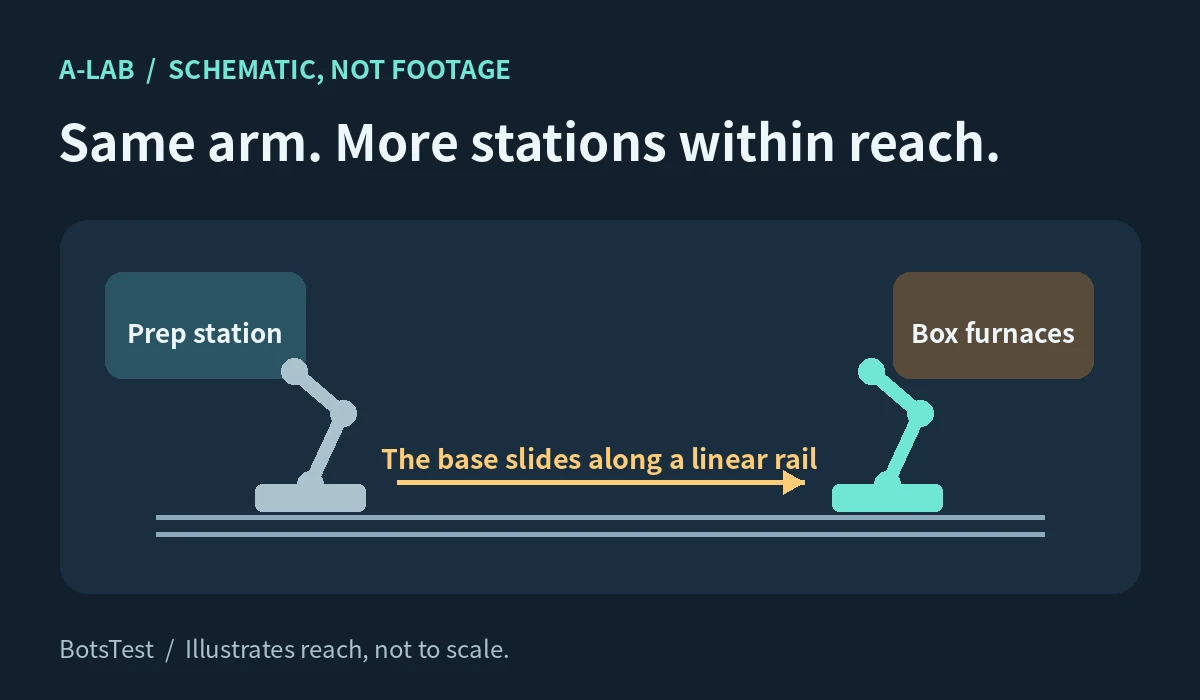
Moving the base shifts the arm’s reachable area. Original BotsTest schematic; not to scale and not a measured reach map. Physical A-Lab rail documented in Extended Data Fig. 2d.
If you’re evaluating a similar setup, the useful question is not just how far the carriage travels. At each intended stop, can the arm reach the actual handoff point in the right orientation? Think of the rail as part of the arm’s reach, not just a way to get between stations.
A-Lab paper, Extended Data Fig. 2d and Supplementary Video 2 · BotsTest UR5e listing
Turn the shortlist into a decision
Write down the task, operating conditions, success criteria and total ownership costs. Ask shortlisted suppliers to demonstrate your representative task, including failure recovery. Use the same acceptance test for each candidate.
Explore the full robotics directory →