When Upkie rolls off a step, its wheels can keep turning even after they lose contact. The open-source wheeled biped uses its wheels to balance, so knowing whether the floor is still supporting it matters. Inria- and ENS-affiliated researchers Ü. Bora Gökbakan, Frederike Dümbgen and Stéphane Caron tested whether the robot could detect leaving and regaining contact with its existing sensors. They first posted the study in October 2024 and revised it in January 2025. Those are publication dates; the paper doesn’t give the dates or precise venue of the physical trials.
The researchers built a real test course: a flat floor, a meter-long ramp inclined at eight degrees, a three-centimeter drop onto a platform, then a twelve-centimeter step down. Five laps produced ten drops. On that course, combining torque and acceleration produced fewer false takeoff and landing alerts than using torque alone.
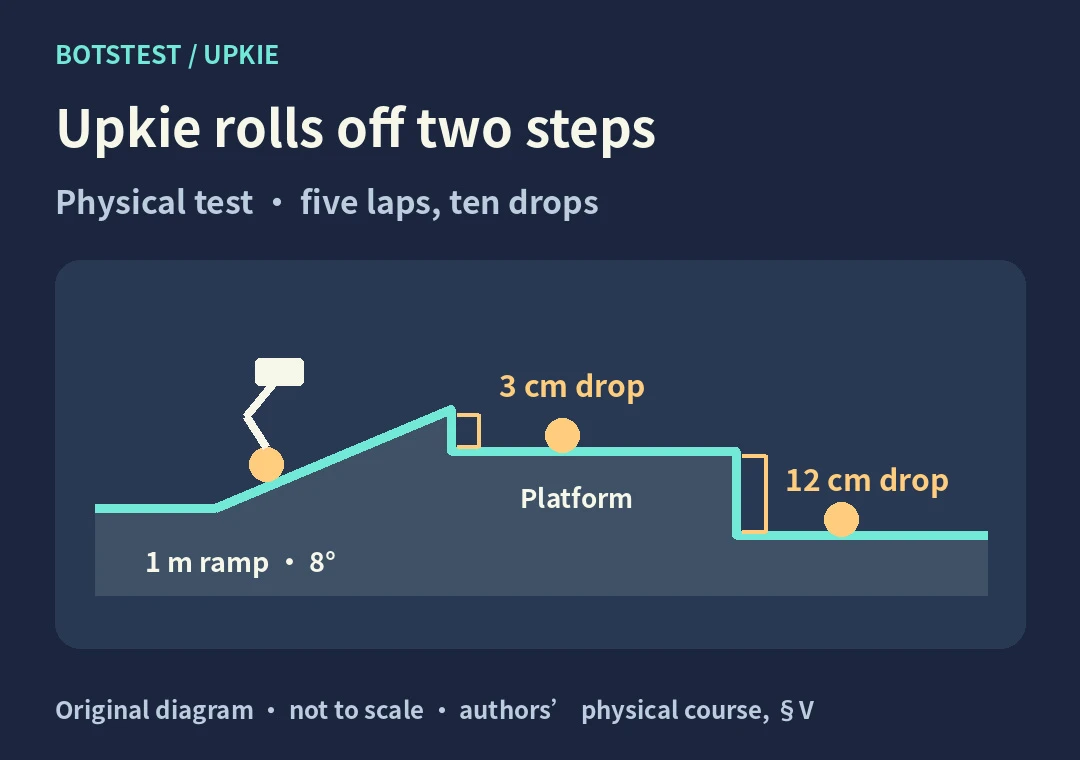
BotsTest drawing based on the authors’ description in Section V. Not to scale, not footage and not a measured trajectory.
Use two cues rather than trusting one
The paper’s separate study of sensor noise used 25-centimeter steps in simulation, not on the physical course.
Torque at the wheels and knees gives a clue about whether the robot is supported. But an ordinary balancing movement can also change the torque and produce a false alert. The researchers learned what torque readings tend to look like with and without contact, then used acceleration from the robot’s inertial measurement unit (IMU) to help estimate when the contact state might change. A Bayesian filter combines those clues over time. A camera helped the researchers label the data; the filter itself did not use camera images or a dedicated wheel-ground contact sensor.
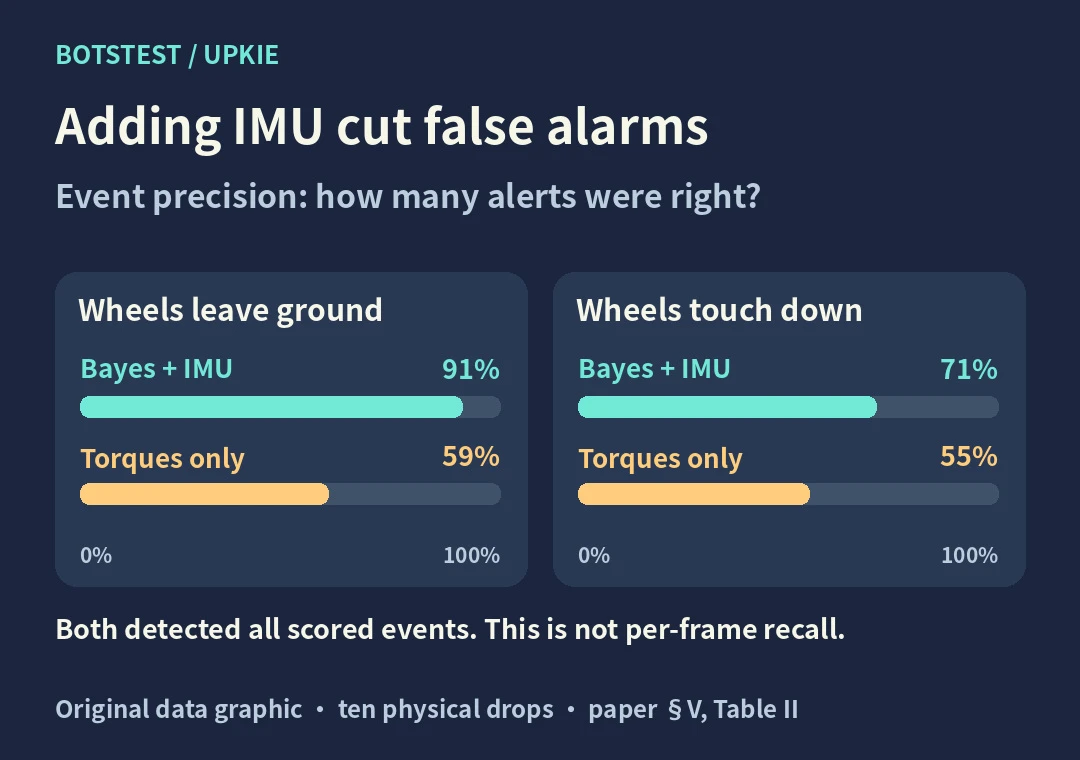
BotsTest visualization of Section V, Table II. Figures are from the authors’ ten-drop physical test, not new BotsTest measurements.
Fewer false alerts is not perfect detection
In that test, the authors reported 91% takeoff precision and 71% landing precision, compared with 59% and 55% for their torque-only variant. Precision asks how many alerts corresponded to real events. Both versions detected all recorded takeoffs and landings under the study’s event-scoring rules, but that did not mean every instant in the air was correctly labeled: the full filter’s recall on individual airborne samples was 37%.
That’s the distinction that makes the experiment useful: a robot can flag that it left the ground and still be late enough to mislabel part of the brief flight. The paper evaluates contact detection, not how often the robot avoided a fall. BotsTest did not repeat the test.
Study, §§ IV–V · Preprint history · Authors’ implementation · Upkie official project
Turn the shortlist into a decision
Write down the task, operating conditions, success criteria and total ownership costs. Ask shortlisted suppliers to demonstrate your representative task, including failure recovery. Use the same acceptance test for each candidate.
Explore the full robotics directory →