A quadruped that stands 26 cm tall doesn’t need 26 cm of headroom if it can change its posture. In a physical obstacle test, SoloParkour researchers Elliot Chane-Sane, Joseph Amigo, Thomas Flayols, Ludovic Righetti and Nicolas Mansard reported that Solo-12 crawled under an obstacle with 20 cm of clearance. Their first arXiv preprint was submitted September 20, 2024. The exact test date and location aren’t reported.
Because rendering depth images from the start of training is costly and the real robot cannot see the simulator’s hidden terrain geometry, the team first trained with simplified terrain information, then reused that experience to teach a depth-based controller that could crouch and crawl on the physical robot.
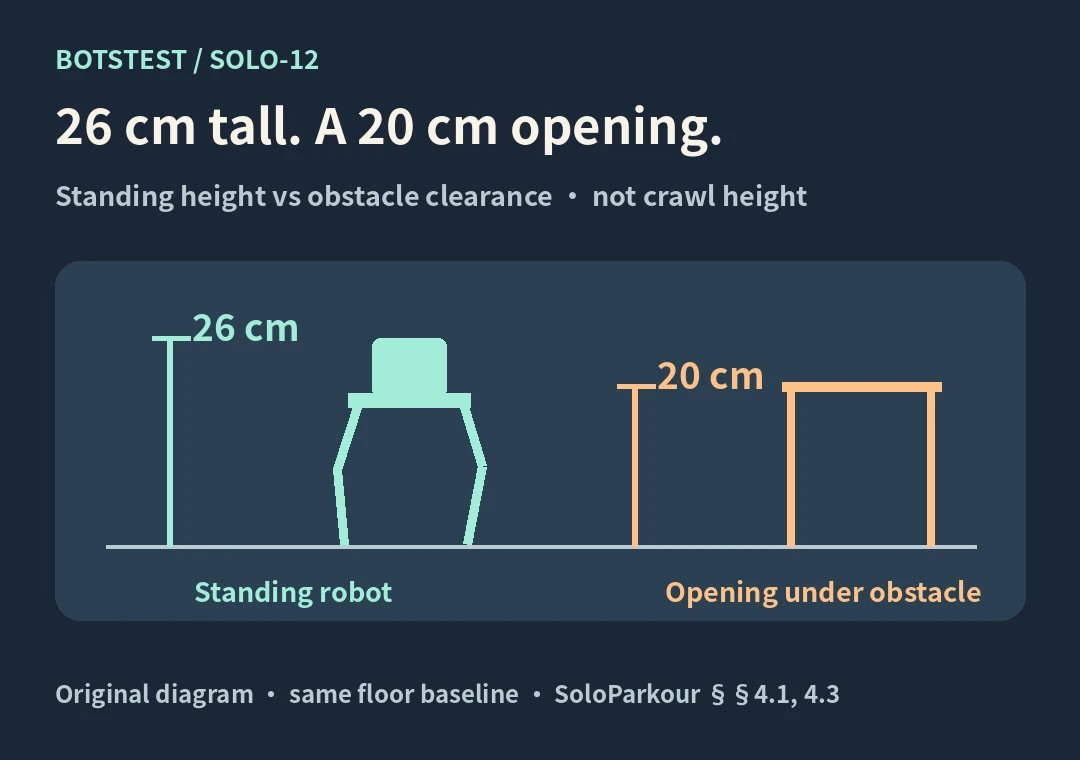
Original BotsTest schematic using the paper’s dimensions. The 20 cm figure is clearance, not a measurement of the robot’s crouched height.
What changes between training and crawling?
In simulation, the first controller gets a simplified description of the terrain. Its experience gives the second round of training a starting point. But the controller that moves the real robot must work with what the robot can actually sense: depth images from the onboard camera and feedback about its own motion and joints. It sends target positions to the joint controller, which moves the legs. The camera helps guide the motion; it does not make the robot shorter. The change in posture is what gives the body room to pass.
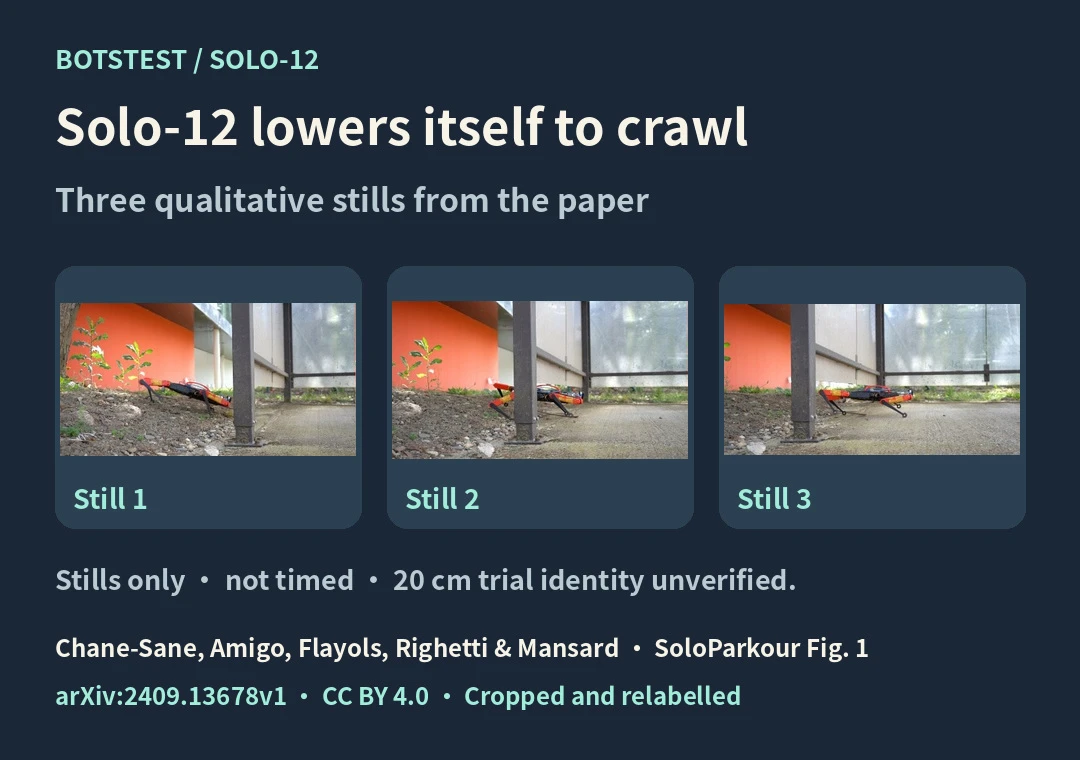
Author photograph of real Solo-12 crawling, cropped and labeled by BotsTest. The image has no measurement scale and is not identified as the measured 20 cm trial.
The photo shows a low posture. The two dimensions come separately from the authors’ experimental report. Neither establishes a universal minimum clearance for Solo-12 on every surface or with every obstacle. BotsTest did not repeat the test.
Photo credit: Elliot Chane-Sane, Joseph Amigo, Thomas Flayols, Ludovic Righetti & Nicolas Mansard, SoloParkour, arXiv:2409.13678v1, Figure 1, CC BY 4.0, cropped and labeled.
First preprint record · Paper: training and physical experiments, §§3.2, 4.1 and 4.3
Turn the shortlist into a decision
Write down the task, operating conditions, success criteria and total ownership costs. Ask shortlisted suppliers to demonstrate your representative task, including failure recovery. Use the same acceptance test for each candidate.
Explore the full robotics directory →