Before a two-legged robot can take a step, it has to lift a foot. Then the other foot has to carry the whole body. What if changing the shape of the thighs could change how quickly the robot tips in that moment? The researchers behind Poppy tested two physical builds: straight thighs and thighs inclined six degrees inward.
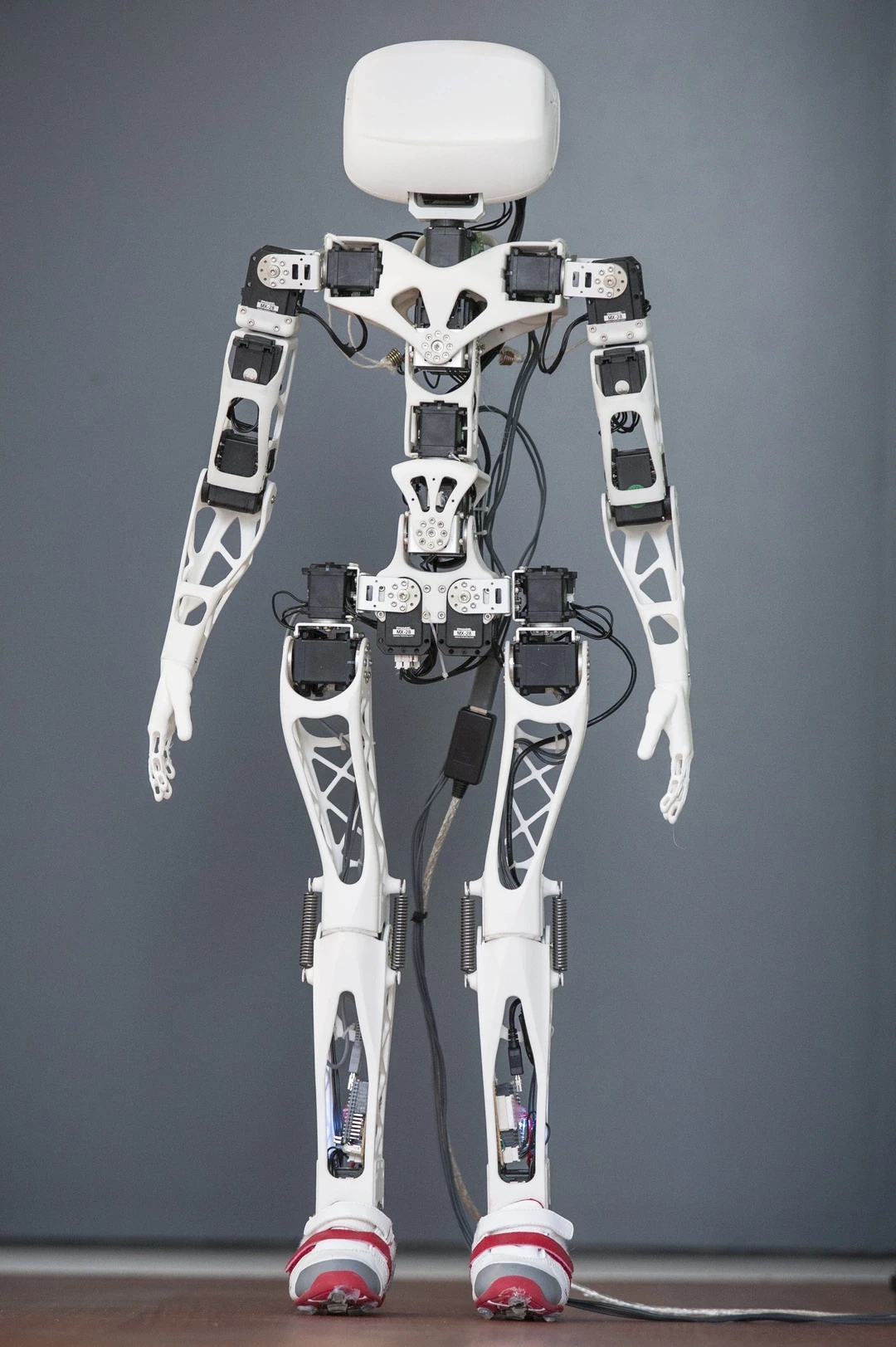
Poppy in an archival photograph dated March 26, 2013, not a still from the one-foot experiment. Inria / Poppy-project.org / Photo H. Raguet. Original photo · CC BY-SA 4.0. Whole image shown without cropping or overlays; the site may compress it for display.

What six degrees changes
On the authors’ explanation, the inward angle brings the feet closer to the point directly beneath the robot’s center of mass. When one foot lifts, the remaining foot starts closer to that point. The change is in the shape of the thighs, not a command to bend the knees or a new balance controller.
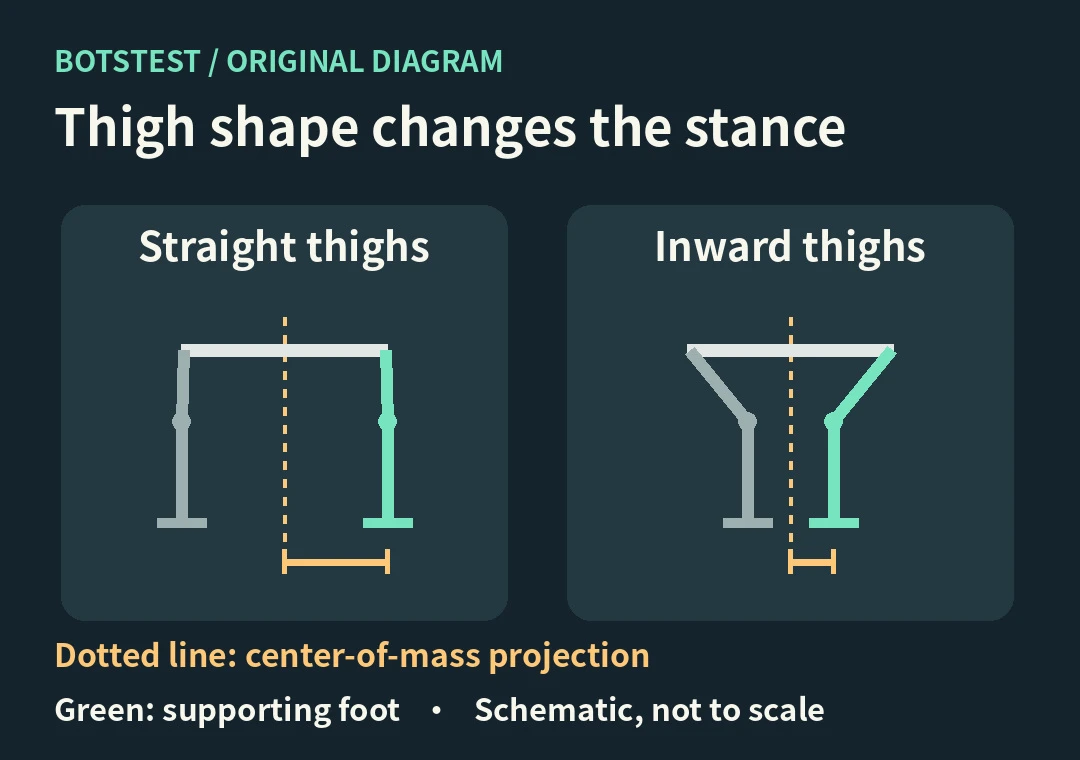
BotsTest schematic based on the authors’ geometric explanation. The lines illustrate relative position only; they are not to scale and do not show measured trajectories.
What the researchers measured
Matthieu Lapeyre, Pierre Rouanet and Pierre-Yves Oudeyer, with Inria’s Flowers team, tested the two thigh builds on the physical Poppy platform. Starting with both feet on the ground, a motor command raised one foot. OptiTrack followed markers on the robot’s head as the robot tipped sideways. The public preprint is dated September 11, 2013. That is not a recording date, and the authors do not specify the experiment’s exact venue.
The researchers reported that, over the first 700 milliseconds, the head’s vertical falling speed was about 56% lower with the six-degree thighs than with straight thighs. They caught the robot before it hit the floor; the catch affected the curves around 800 milliseconds. The head was the measured point, not the whole body’s center of mass. And the number tells us about the early speed of the fall, not whether Poppy fell less often or could walk unaided. The paper’s simplified simulation and its separate, human-guided treadmill trial are not the source of this physical measurement.
That distinction makes the result useful: changing where the support foot sits changed how quickly this robot tipped when the other foot lifted. It did not make the balance problem disappear. This was the authors’ experiment, not a BotsTest replication.
Turn the shortlist into a decision
Write down the task, operating conditions, success criteria and total ownership costs. Ask shortlisted suppliers to demonstrate your representative task, including failure recovery. Use the same acceptance test for each candidate.
Explore the full robotics directory →