Reaching the handle is not enough. The robot has to grip it and pull until the latch gives. Beomjun Kim and five coauthors tested whether human video could teach that action without collecting robot demonstrations. In their tabletop experiment, an OpenArm bimanual robot with Inspire RH56F1 hands opened the microwave in 21 of 24 trials using Dexterous Point Policy. The paper’s adapted VITRA baseline succeeded once in 24 trials.
The microwave started fully closed in one of four randomized positions on the table. A human evaluator counted a success if the latch released and the door moved past the closed position within three minutes, allowing time for the robot to recover. The authors posted the preprint on June 9, 2026; they did not specify the trial dates or the exact test location.
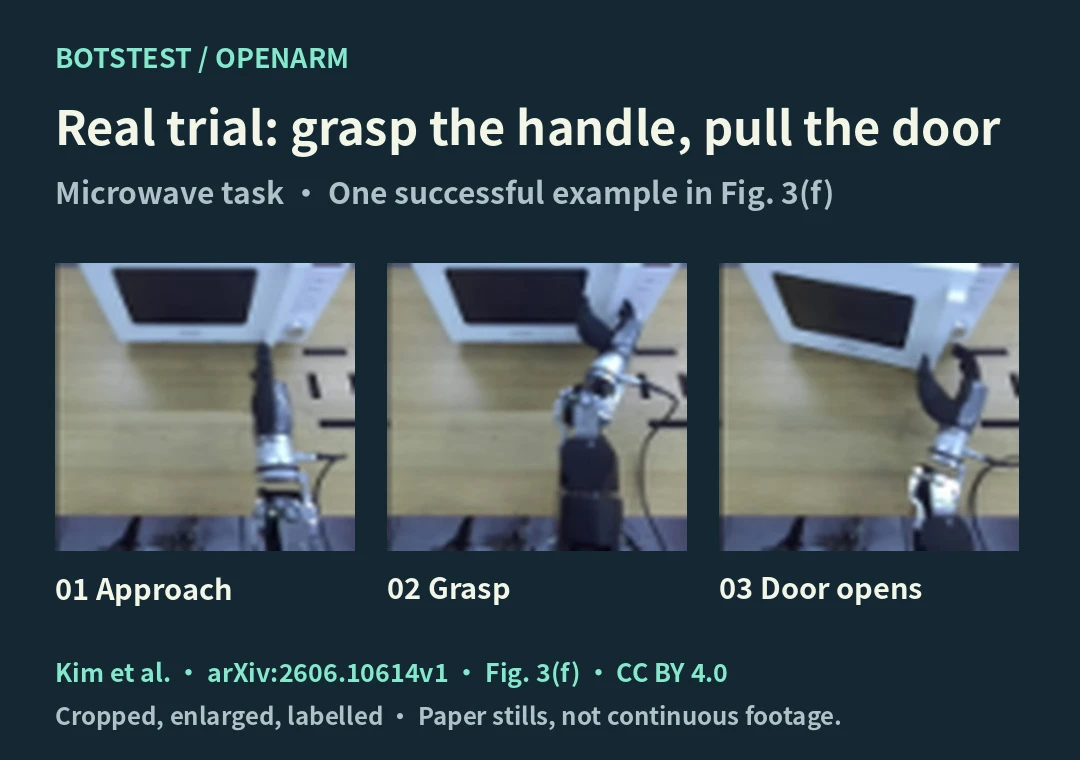
Representative author-published success, not all 24 trials. Beomjun Kim, Seong Hyeon Park, Seunghoon Sim, Seungjun Moon, Sanghyeok Lee and Jinwoo Shin, Dexterous Point Policy, arXiv:2606.10614v1, Figure 3(f), CC BY 4.0. Cropped to panel (f); localized caption added.

Teach the wrist and fingertips, not the human joints
Human fingers and robot joints don’t bend the same way. Dexterous Point Policy describes both hands with the same six points in 3D: the wrist and five fingertips. It also tracks relevant points on objects. For the microwave task, the authors started with a model pretrained on human video and fine-tuned it on 100 human demonstrations of that task, not robot recordings. At deployment, inverse kinematics translated the predicted points into commands for the robot’s joints. Predicted contact prompted a small extra closing motion; it was not a direct measurement of fingertip force.
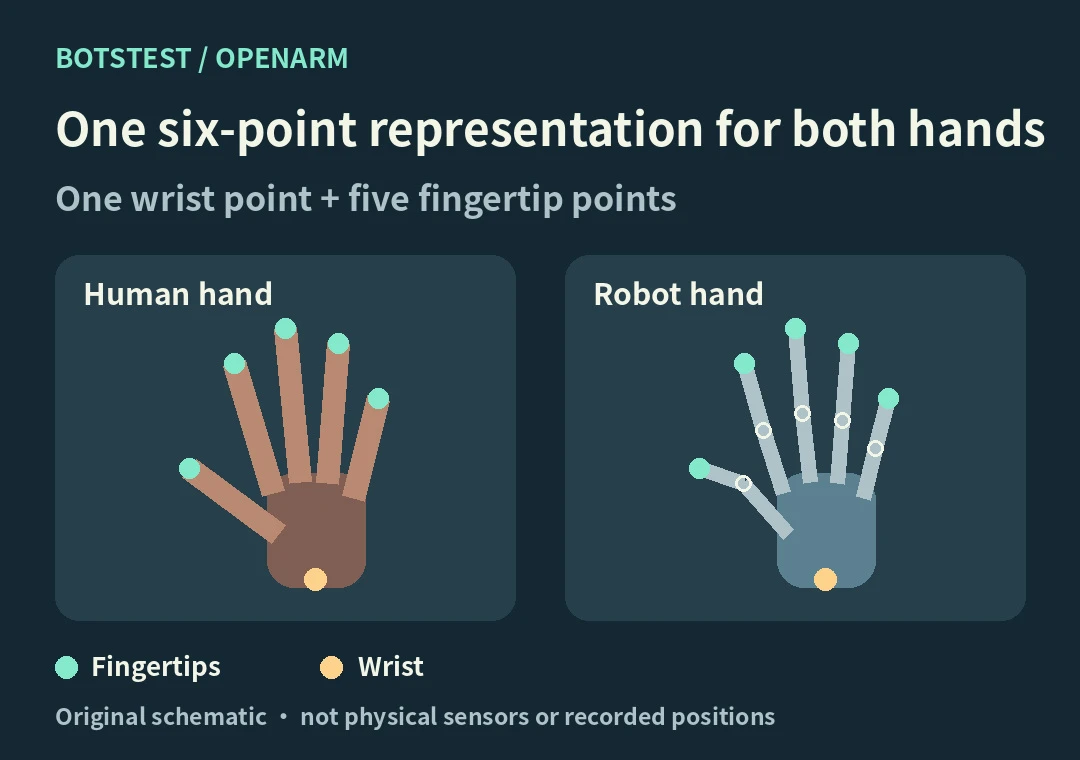
BotsTest illustration of the representation in the authors’ method. It does not show measured trajectories or force.
What 21 versus one actually compares
The VITRA baseline was adapted for this experiment. It used the same large human-video corpus for pretraining and the same task demonstrations, with human hand points converted into joint-angle targets for fine-tuning. It then predicted joint angles directly. The comparison therefore covers two policy pipelines, not two different robots or the effect of changing just one part of the algorithm.
The counts come from the paper’s Table 1 rates (87.5% and 4.2%) and its 24 trials per method. Figure 3(f) illustrates one success; it does not establish the totals. The experiment shows that this particular robot could learn this defined task from human video without robot demonstrations. It does not show that it can open any appliance or work reliably in an unfamiliar kitchen. BotsTest did not repeat the test.
Turn the shortlist into a decision
Write down the task, operating conditions, success criteria and total ownership costs. Ask shortlisted suppliers to demonstrate your representative task, including failure recovery. Use the same acceptance test for each candidate.
Explore the full robotics directory →