The plug is right in front of the socket. In a close-up, that looks like the hard part is over. Think about plugging in a phone under a desk: your eyes get you close, but your hand tells you when the connector catches on the rim. For a robot, those are two different signals, and the moment they disagree is the interesting part.
Looking aligned isn’t the same as fitting
In the wrist camera view from the CRIA dataset, a Franka Research 3 brings a USB-C plug towards an orange fixture. The angle shows the approach, not whether the plug seated completely. The authors mark Episode 0 successful; this image is from a human-teleoperated demonstration, not an autonomous run or an independent BotsTest test.
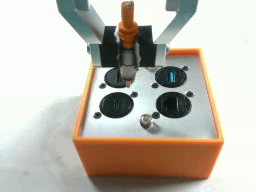
Human-teleoperated USB-C insertion demonstration, not an autonomous test. Unmodified still extracted at 7.7 s from Qiao et al., CRIA, insert_typec, Episode 0, wrist camera; CC BY 4.0. This view does not confirm full seating.
The camera helps locate the plug and port. A force/torque sensor instead measures how contact pushes back or twists on the tool. For example, a plug can look nearly centered and still press sideways against an edge. A force reading alone does not tell you that a plug is fully inserted either.
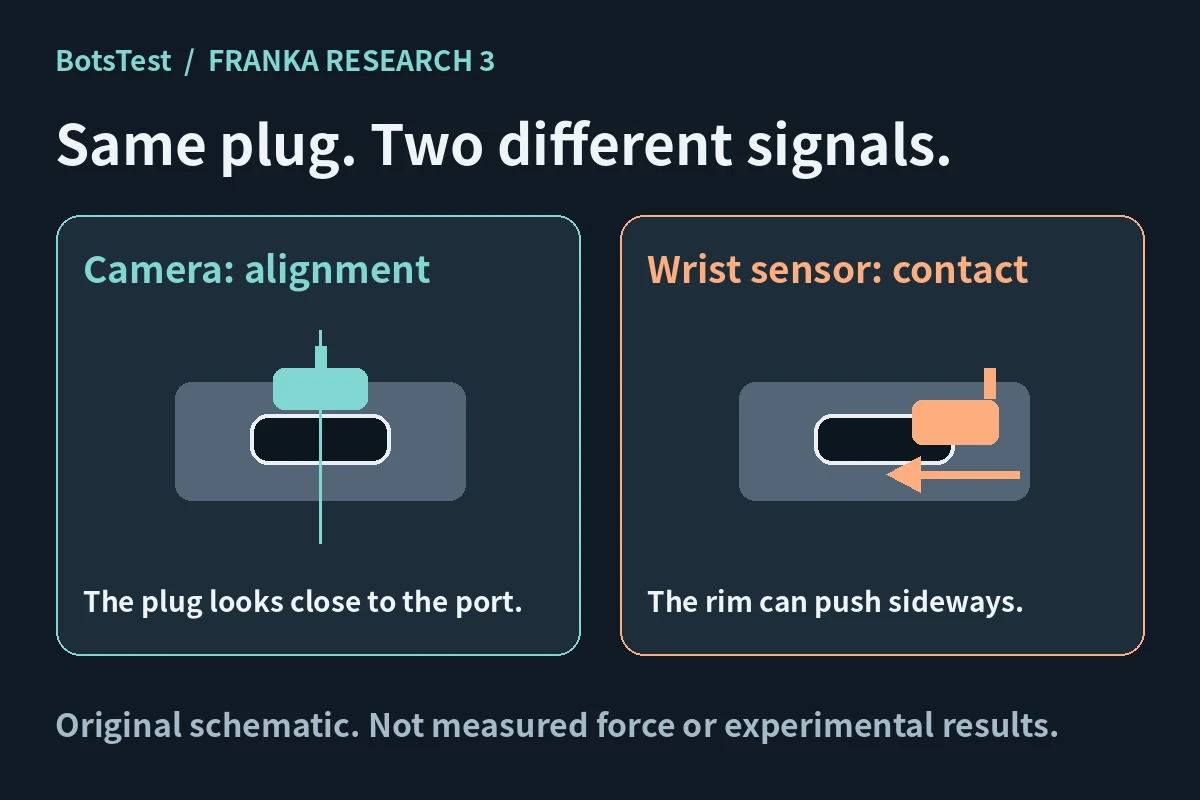
Where it looks versus how contact pushes back. Original BotsTest schematic; illustrative, not measured force or experimental results.
Which sensor did the researchers actually use?
Franka says the standard FR3 has torque sensors built into its joints. Qiao and colleagues separately describe fitting an ATI Axia80-M8 six-axis force/torque sensor at the wrist for CRIA. The add-on is not the factory joint sensors, and this setup does not make it part of the standard FR3.
For an insertion test, log the view, contact response, and final outcome separately. It’s a better way to distinguish “couldn’t line up” from “lined up and caught an edge” than inspecting the last frame alone.
MAIA paper, § IV-B–C · Franka manufacturer specifications · BotsTest FR3 listing
Turn the shortlist into a decision
Write down the task, operating conditions, success criteria and total ownership costs. Ask shortlisted suppliers to demonstrate your representative task, including failure recovery. Use the same acceptance test for each candidate.
Explore the full robotics directory →