A camera can spot a blue ball. That alone won’t move a rover. From October 29 to November 1, 2024, ESA Academy and ESA’s Automation and Robotics Section gave 30 students in six teams both jobs. They used ExoMy, a 3D-printed educational rover developed at ESA, at the Erasmus Innovation Centre at ESA’s ESTEC in Noordwijk, the Netherlands. Their indoor Mars-like terrain was a test setting here on Earth.
Each team put a physical rover at a known starting point. The software was not given the ball’s location: it had to find the blue target and drive toward it. Workshop trainer Marti Vilella Ramisa reported that all six teams completed the task. ESA did not report how many attempts they needed, so that is a tally of teams, not a success rate per run.
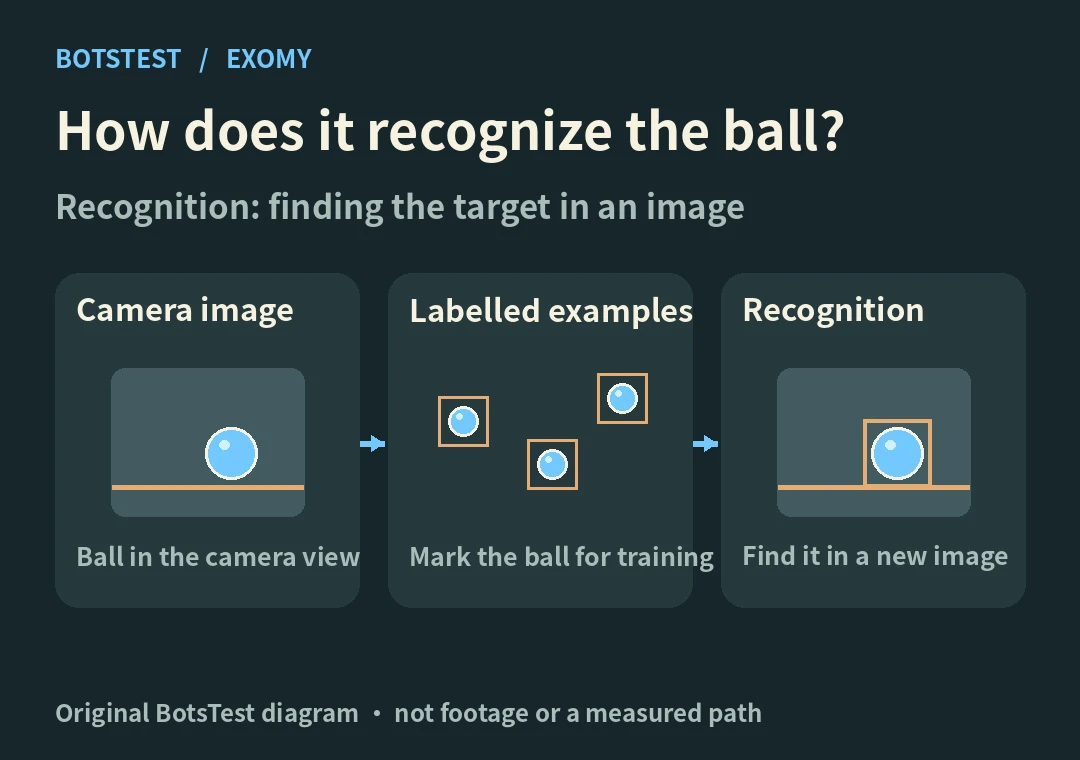
Recognizing the ball begins with marking where it appears in photos. BotsTest schematic, not workshop footage.
First teach it what to look for
The students first practiced driving in computer simulation with a gamepad. Then they used the physical rover’s camera to take hundreds of photos of the ball and marked where it appeared. They used the labeled images to train a detector. Now the software could tell whether the ball was in an image and where in the frame it appeared. Recognizing the ball still didn’t tell the wheels what to do.
Then turn recognition into movement
On the final day, teams connected object recognition to rover movement. The useful distinction is between “there’s the ball in this frame” and “drive toward it.” ESA used a Mars communication problem to motivate this: over long distances, instructions take time to arrive, so a rover that can do some tasks itself does not need a fresh command for every step. The workshop did not measure that communication delay.
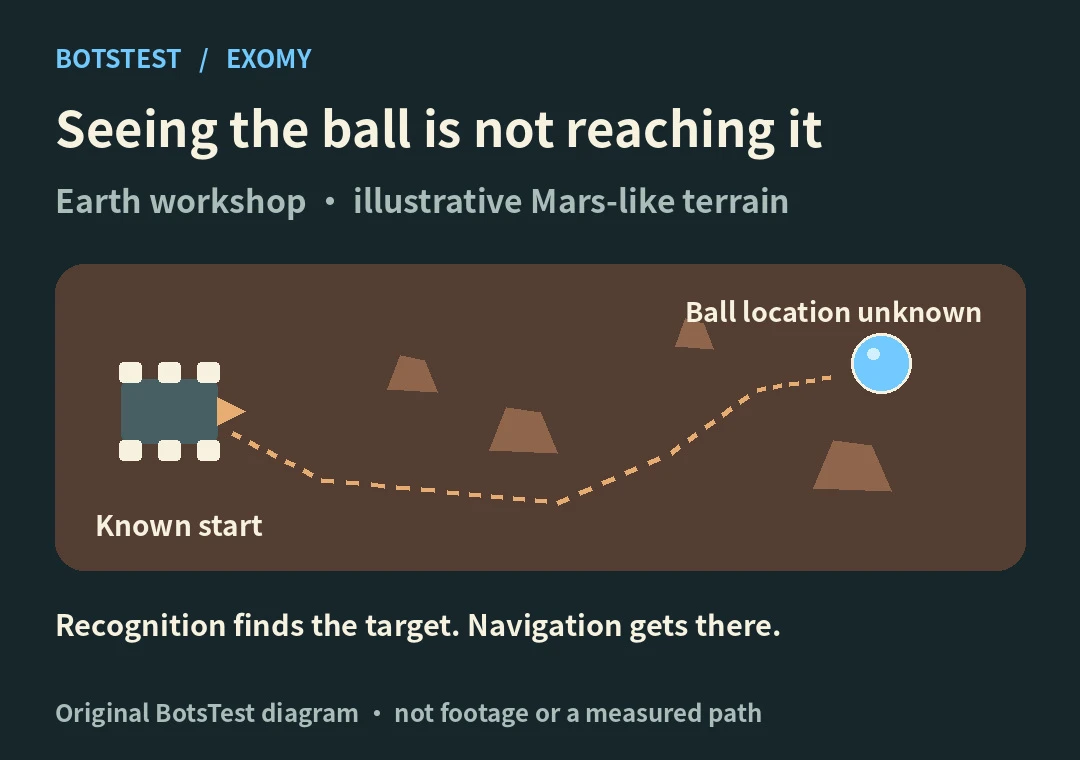
BotsTest schematic showing the challenge inputs and goal, not a recorded or measured path.
The workshop demonstrated both jobs working together for this classroom task. It did not establish how the software searched or planned a route, whether the result would repeat under other conditions, or whether the rover could pick up the ball. BotsTest did not rerun the test.
ESA’s ExoMy project · ESA Academy workshop report, November 15, 2024 · ESA’s trainer account, November 6, 2024 · ESA venue information
Turn the shortlist into a decision
Write down the task, operating conditions, success criteria and total ownership costs. Ask shortlisted suppliers to demonstrate your representative task, including failure recovery. Use the same acceptance test for each candidate.
Explore the full robotics directory →