Anubis and Horus could walk in circles. That was the point. At Haverford College in Pennsylvania, undergraduate researchers Deep Patel and Willow Kohn used two Petoi Bittle robot dogs in physics professor Suzanne Amador Kane’s lab. The project was underway in summer 2023. Instead of teaching the dogs a new trick, the team wanted to see what changed when their feet met a different surface.
In the early setup, a joint kept the robot on a circular track. The surface could be swapped, and the team could look separately at slipping, walking speed and electrical power draw. By the time Haverford wrote about the work on October 8, 2024, the team had switched to a straight track and was adjusting the gait. That’s the report date, not an experiment date.
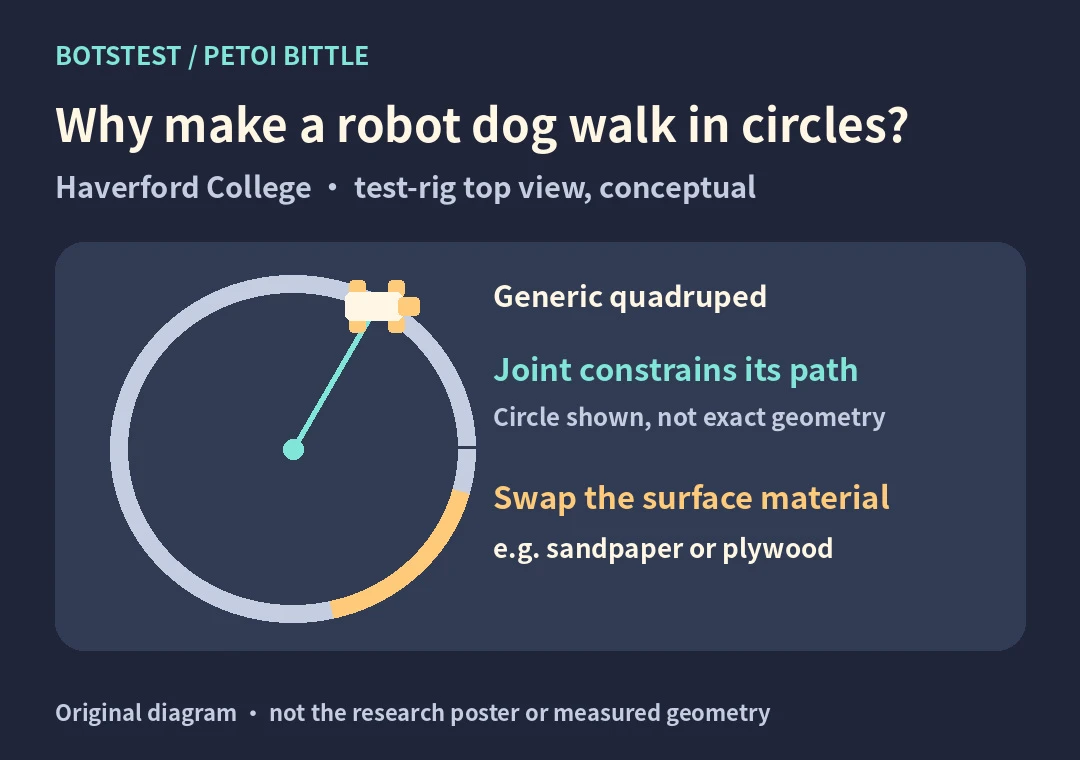
Original BotsTest schematic of the early test setup described by Petoi and Haverford. Not a photograph, to-scale reconstruction or drawing of the later straight track.
The circle made the walk easier to measure
An open-floor demo can tell you that a robot moved. A testbed lets you ask what changed between walks. Petoi’s account says the team used a universal joint to keep Bittle on the circular track and could replace the surface with materials such as sandpaper or plywood. The arrangement defined the route, while leaving the contact between the robot’s feet and the ground as something to investigate.
The lab wanted to know how both the foot design and the surface affect the way a robot walks. A foot can slip, the robot’s pace can change, and its electrical power draw can change. Those are different observations. Tracking markers gave the camera a way to follow motion, while a power tester displayed electrical draw.
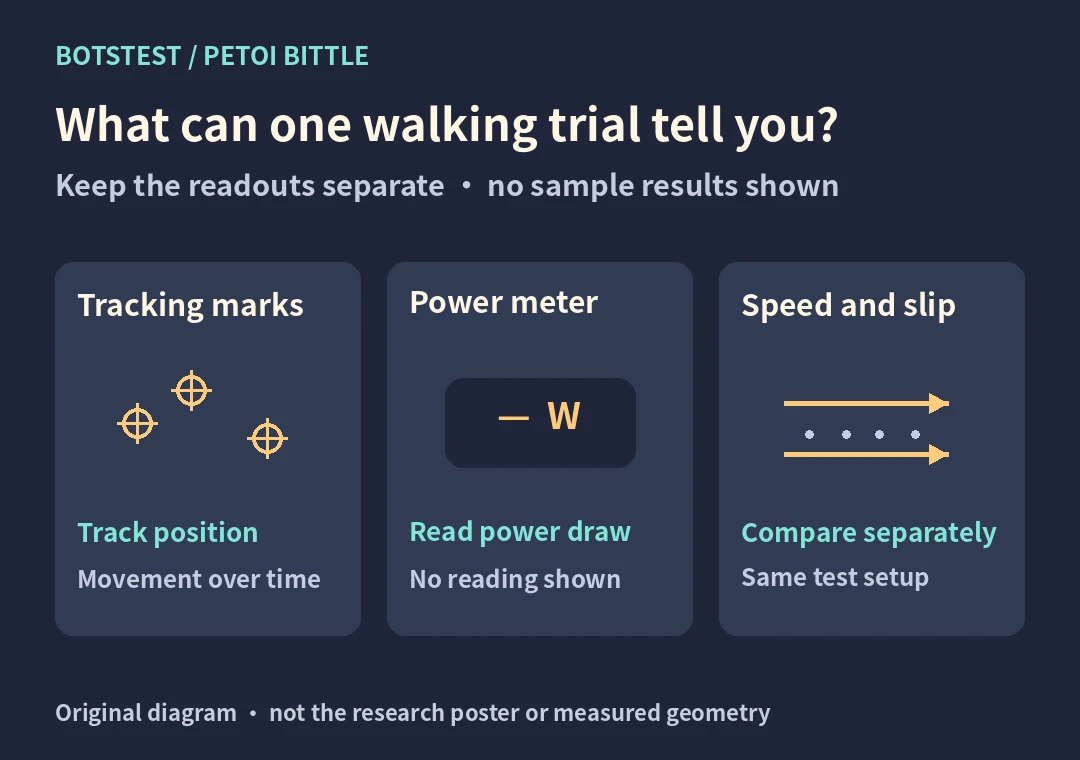
Original BotsTest schematic of what the team wanted to measure. No numbers or trajectories shown here are experimental data.
What the setup doesn’t prove
Haverford describes a preliminary observation about friction. The public reports don’t establish a general rule for robot dogs, quantify the effect for each surface, or isolate the cause. The later adjustments to the track and gait are a useful reminder: before comparing two results, ask whether the robot was walking under the same conditions. BotsTest did not repeat the test.
Haverford College report, October 8, 2024 · Petoi's account of the testbed, October 23, 2024 · Petoi Bittle model
Turn the shortlist into a decision
Write down the task, operating conditions, success criteria and total ownership costs. Ask shortlisted suppliers to demonstrate your representative task, including failure recovery. Use the same acceptance test for each candidate.
Explore the full robotics directory →