The easiest gripper to miss is the one that never picks up the battery. The overhead frames below come from a human teleoperation demonstration on real hardware; they show stability and alignment, not an autonomous trial or proof that the battery seated fully.
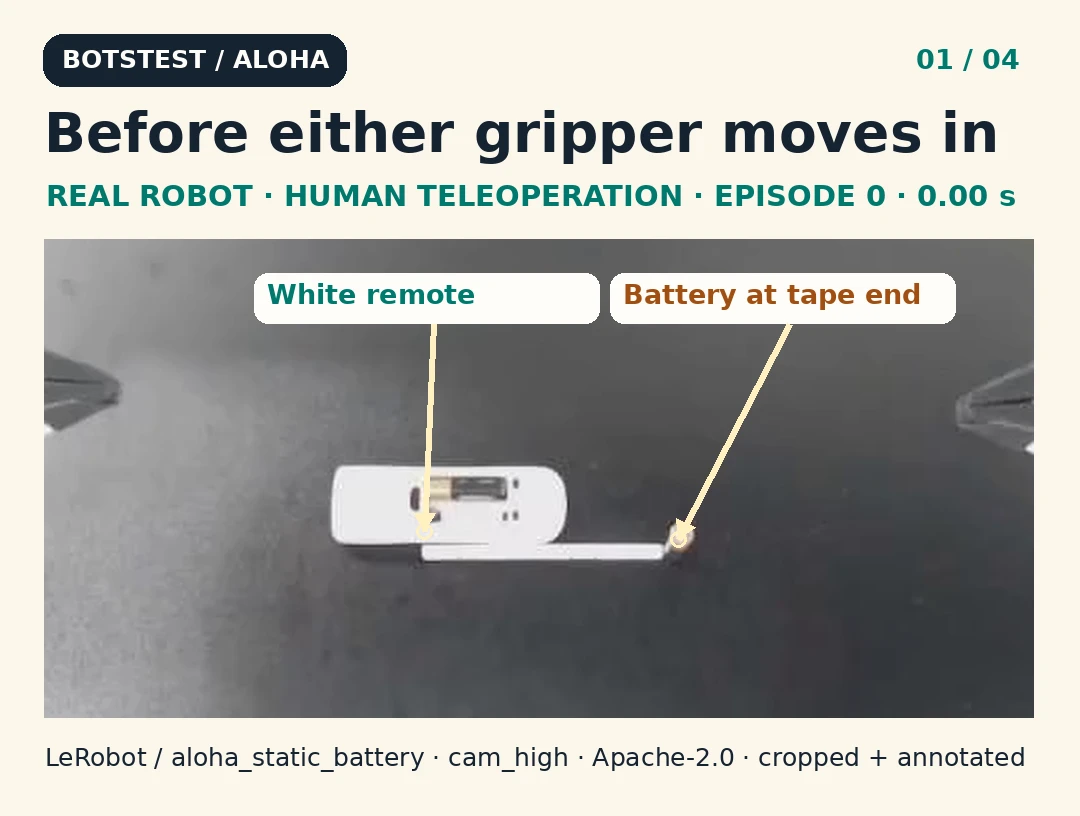
LeRobot ALOHA battery data, episode 0, cam_high, 0.00s. Human teleoperation on real hardware; cropped and annotated. Source · Apache-2.0.
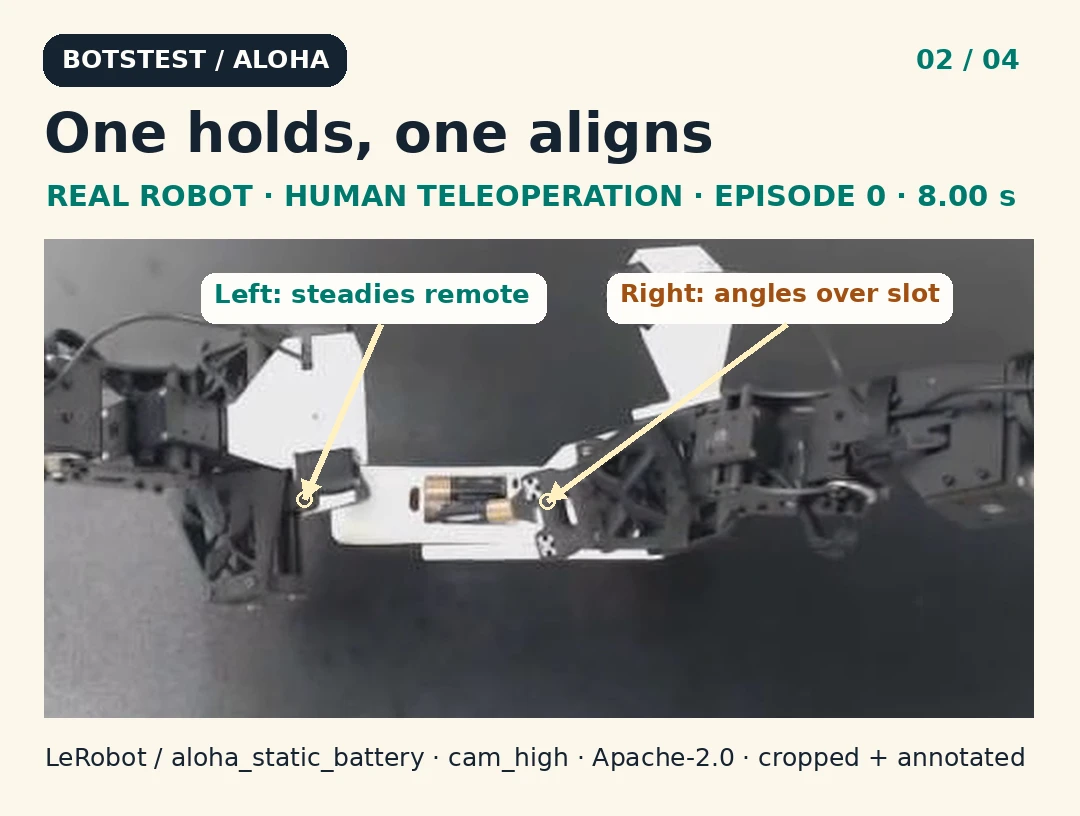
Same episode and camera, 8.00s. Angling toward the slot is visible; fully seating the cell is not established by this view. Cropped and annotated. Source · Apache-2.0.
Why the second arm matters
The official ALOHA project describes an open-source hardware system for fine bimanual manipulation and imitation-learning research. In the authors’ battery task, the right gripper places the battery and presses it in with its fingertips. Pressure on the slot spring can push the remote in the opposite direction. The left gripper bears down on the remote to keep it still. This is the authors’ approach to this setup; it does not prove a fixture or another design could not do the job.
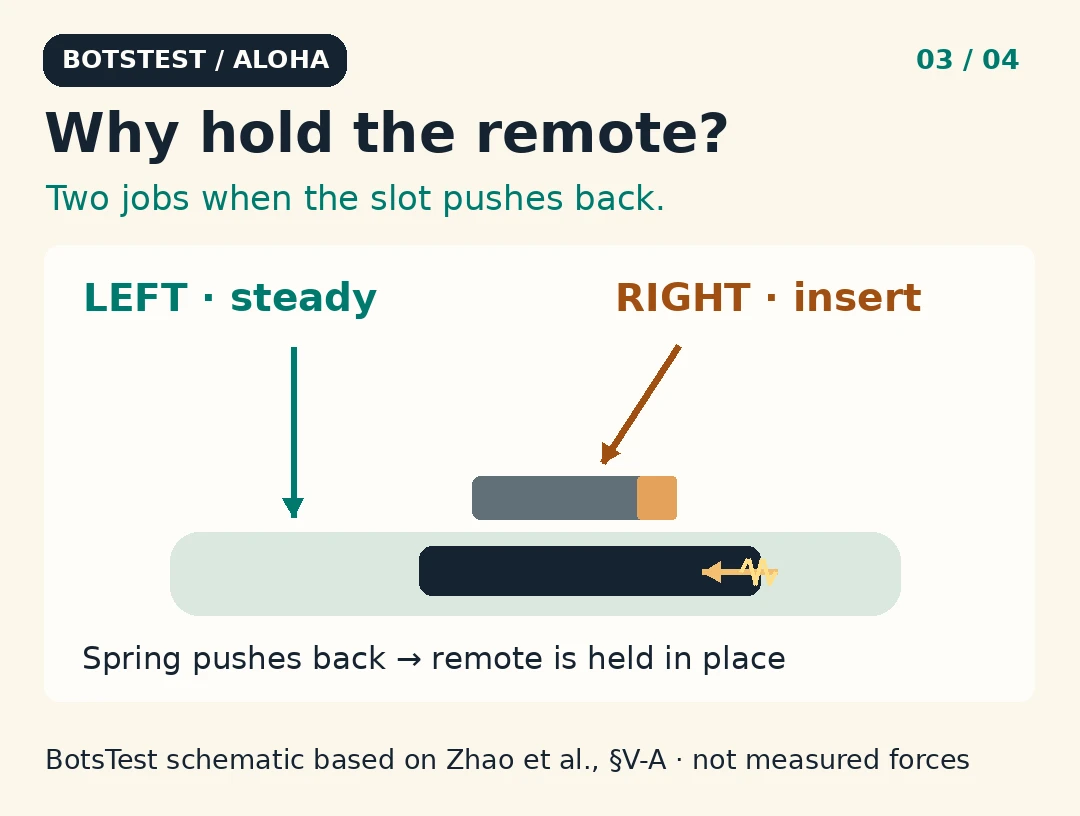
BotsTest diagram of the authors’ setup in §V-A. It is an illustration, not measured force.
What 96% actually measures
In the authors’ §V-A and Table I, ACT reached 100% at grasping, 100% at placing, and 96% at fully inserting the battery: 24 of 25 attempts on real hardware, with one training seed. That comes from their separate policy evaluation. It is not the result of the teleoperated dataset clip and it is not a BotsTest test. The paper describes randomizing object positions along a 15 cm reference line in the physical tasks. These results do not establish performance with a different remote, wider starts or another seed.
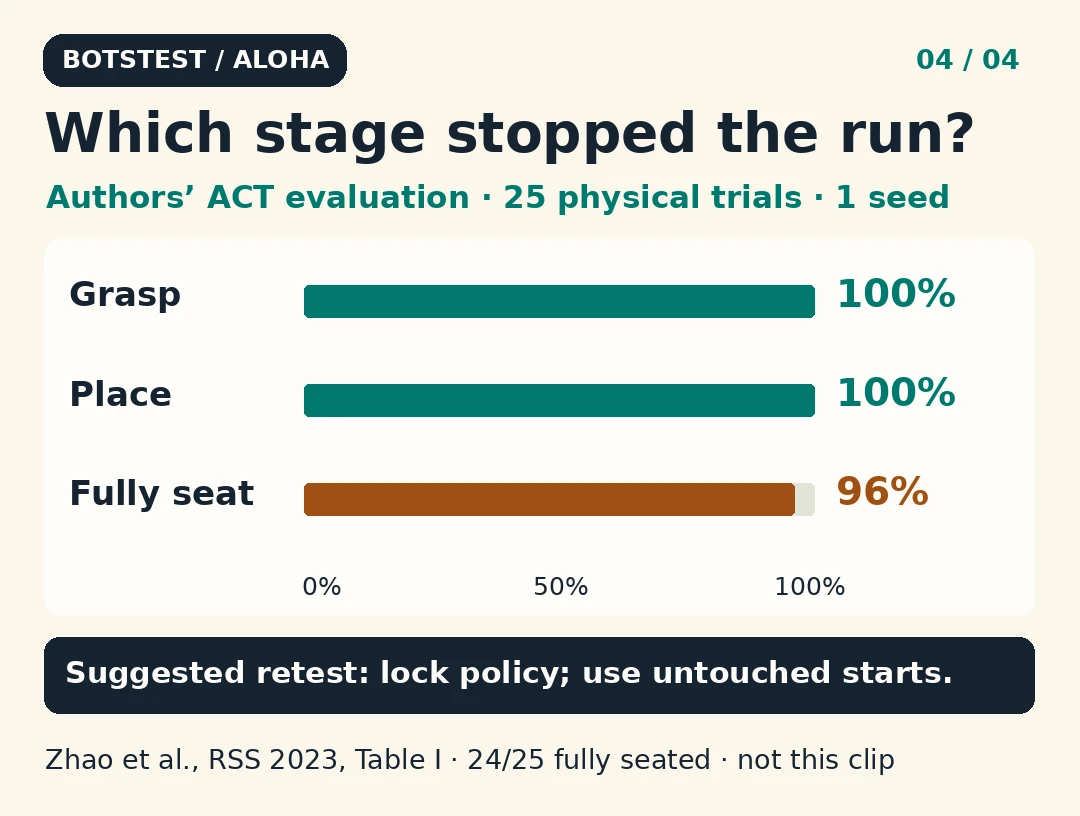
Zhao et al., RSS 2023, Table I. 25 physical trials, one training seed. The retest checklist is a BotsTest suggestion, not an experiment.
Score the stage that failed
Keep the remote, battery, allowed starts, deadline and retry rules fixed. Define what counts as grasp, place and fully seated, and keep all attempts in your denominator. Log the first failed stage and any human intervention. Freeze the policy and retest on poses not used to tune it. If comparing a fixture against a second arm, change only that support condition and report both results separately. This is a test design suggestion, not a new result.
Sources
Turn the shortlist into a decision
Write down the task, operating conditions, success criteria and total ownership costs. Ask shortlisted suppliers to demonstrate your representative task, including failure recovery. Use the same acceptance test for each candidate.
Explore the full robotics directory →