When one wheel climbs a rock, what happens to the other five? On NASA’s Jet Propulsion Laboratory Open Source Rover, the wheels do not all have to rise together. JPL released build plans so students and hobbyists could learn hands-on how Mars rovers move. It published a photo of a rover it built on a rock pile on July 31, 2018. The scene is on Earth, and the vehicle is a scaled-down open-source build, not Curiosity or a rover that went to Mars.
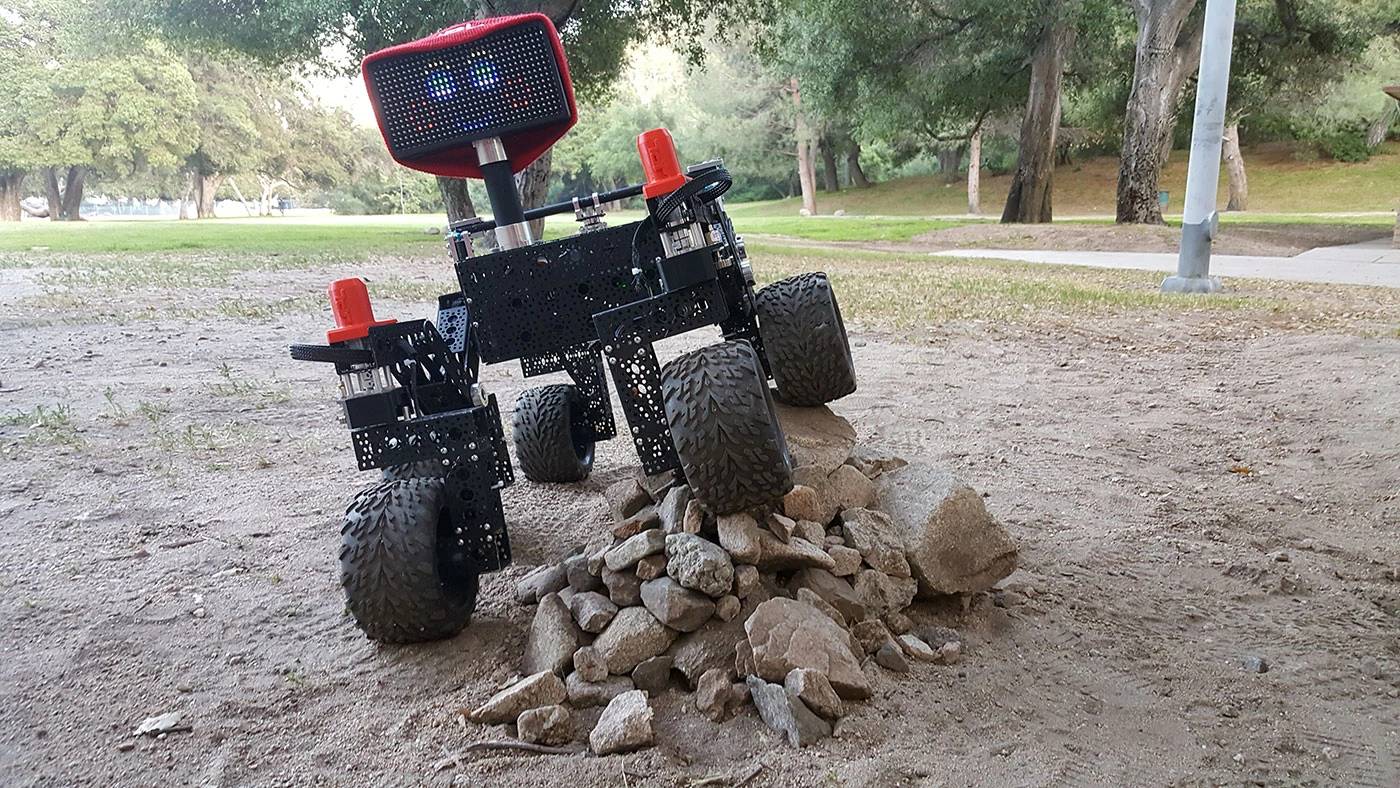
JPL’s 2018 Open Source Rover on a rock pile on Earth. Original photo from the JPL announcement. Courtesy NASA/JPL-Caltech.
Follow the joints, not just the front wheel
Look along one side of the rover. The rocker, a jointed arm, carries the front wheel. The middle and rear wheels share a second arm called a bogie, which pivots relative to the rocker. As the front wheel rises, the arms can change angle relative to each other and the body. This gives the other wheels room to follow different heights instead of forcing them to move with a rigid frame.
There is another link you cannot see clearly in the photo: JPL’s design mechanically couples the left and right rockers through a differential pivot. That coupling helps share load between the sides as the rover climbs. Think of the two side assemblies as teammates: each can adapt to its own patch of ground, but neither works entirely alone.
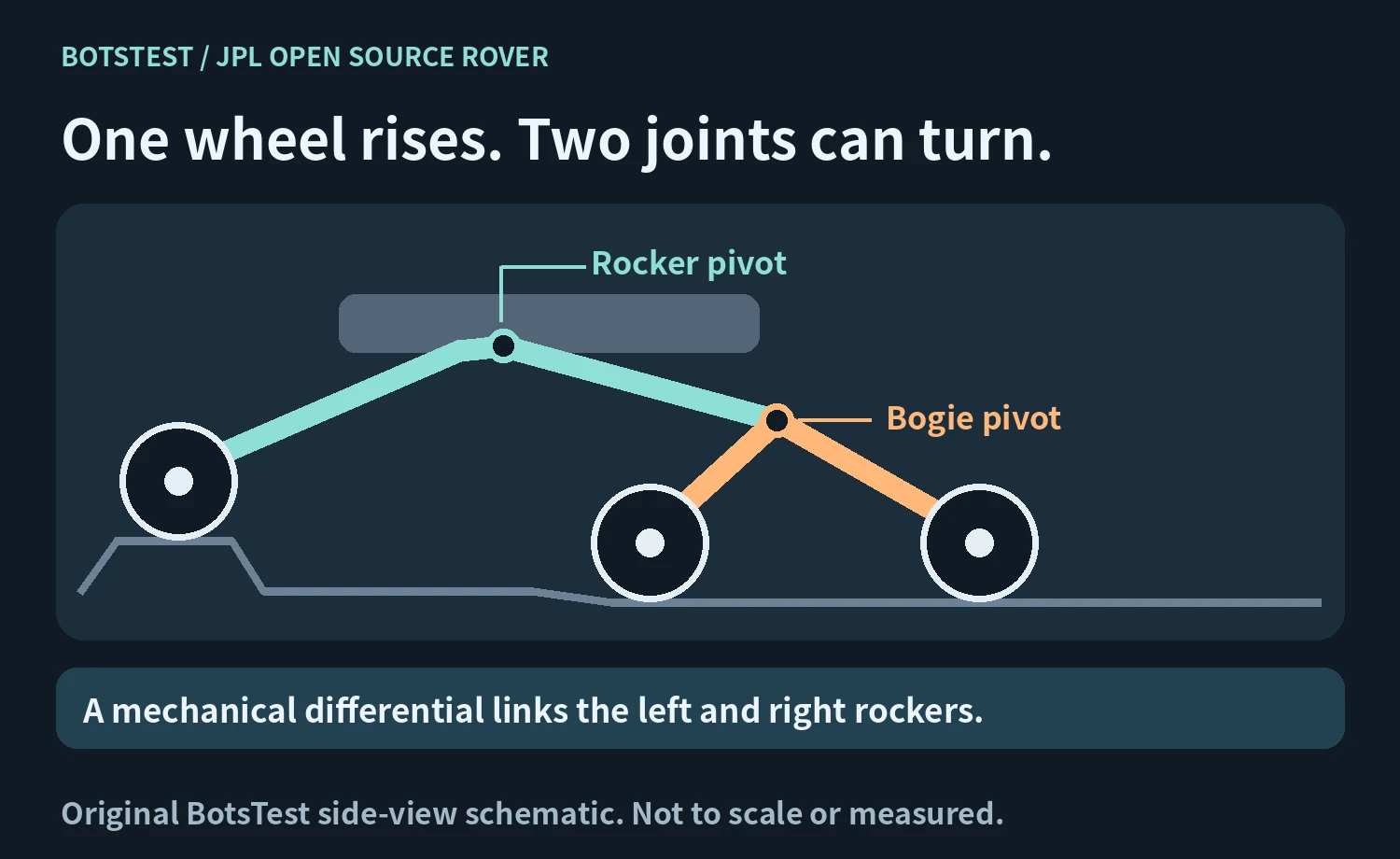
Original BotsTest schematic, not a scale drawing or measured test. The side view identifies the rocker and bogie pivots; the note describes how the left and right sides are mechanically linked.
What this picture can’t tell you
The photo makes the geometry easier to see. It doesn’t give an obstacle-height limit, a success rate, an autonomy result, or a guarantee that all six wheels stay in contact. This is not a BotsTest trial. If you’re evaluating a rover, record which wheel loses contact first and under what conditions rather than judging it by a single dramatic pose.
JPL’s July 2018 announcement · Official mechanical documentation · BotsTest resource page
Turn the shortlist into a decision
Write down the task, operating conditions, success criteria and total ownership costs. Ask shortlisted suppliers to demonstrate your representative task, including failure recovery. Use the same acceptance test for each candidate.
Explore the full robotics directory →