Forty-nine drones can make a ballerina together, but who tells each one where to go? Bitcraze and the Institute for Data Science in Mechanical Engineering at RWTH Aachen University answered that question in an indoor demonstration with 49 physical Crazyflie 2.1 Brushless drones. In its October 26, 2026 report, Bitcraze showed the swarm taking off from charging docks, flying formations and landing to recharge. That is the report’s date; it does not specify the filming date or exact venue.
One Crazyradio 2.0 handled communication, but it did not continuously steer all 49 drones through the routine. Before takeoff, the team uploaded a separate path to each drone. During flight, each drone ran its own stored path, and the team logged its position every 50 milliseconds. The result was a coordinated show in which sharing a radio did not mean sharing a pilot.
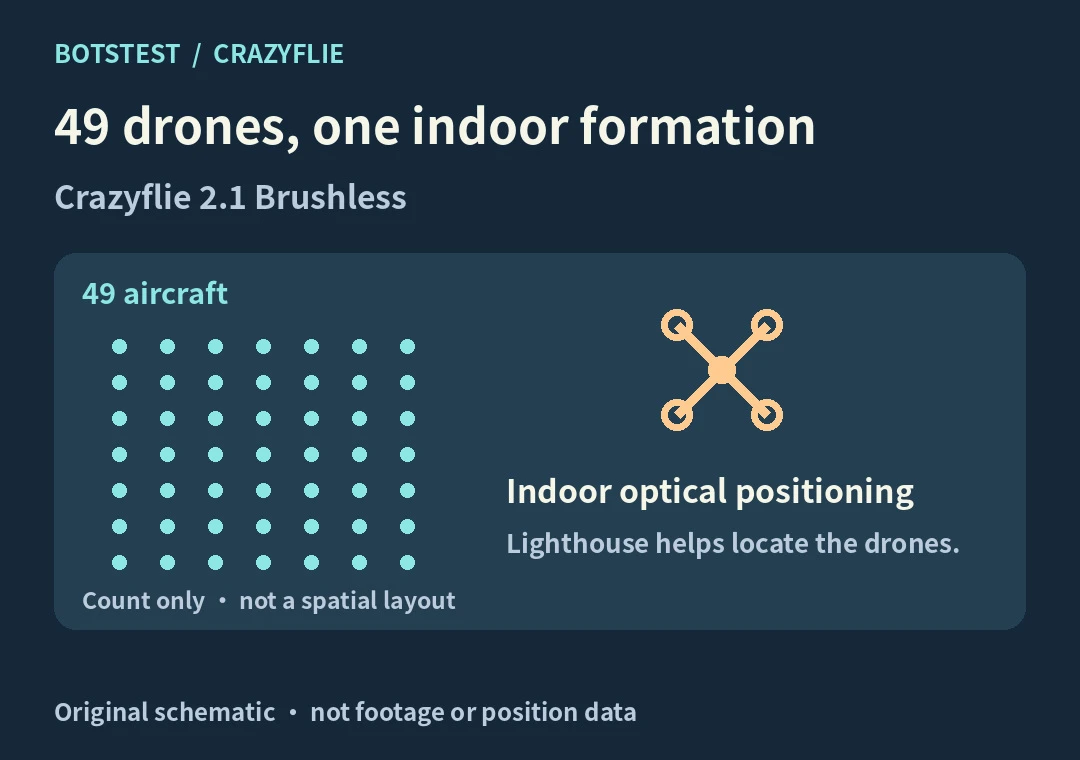
BotsTest illustration of the formation concept, not demonstration footage and not a record of measured positions.
Design the show first; fly the paths second
The team used SWAN, its university partner’s choreography pipeline, to turn the idea for a show into candidate drone trajectories. Those trajectories were represented as smooth curves and sent from the ground station to the individual drones by cflib2 before takeoff. Once airborne, each drone’s onboard High-Level Commander followed its own curve. This was not a model watching the show and deciding the next move live.
The radio and the positioning system had different jobs. The radio carried communications; the Lighthouse optical setup helped each drone determine where it was. Logging positions during flight gave the team a way to compare what the swarm did with what it was supposed to do. A 50-millisecond logging interval is not a claimed control delay or a measure of how accurately the drones followed their paths.
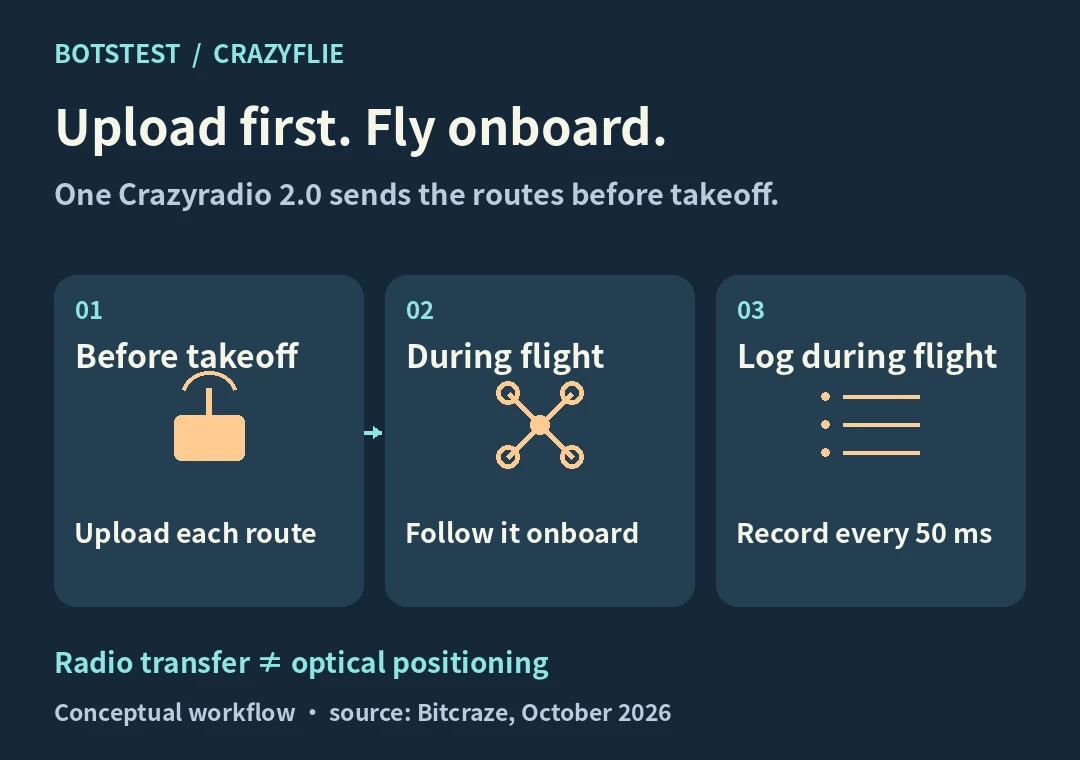
BotsTest schematic based on Bitcraze’s October report. It illustrates the flow of information, not actual transmission timing or flight paths.
What the video does and does not show
Bitcraze says the ballerina and the “I love you” hand sign each used 49 drones; the karate figure used 29. This was an indoor demonstration with dedicated positioning infrastructure, not evidence that one radio suffices under all conditions or that the swarm can fly safely outdoors. The publisher does not report path-error figures for these formations. BotsTest did not repeat the demonstration.
Bitcraze’s original report and video · Crazyflie 2.1 Brushless · SWAN research paper
Turn the shortlist into a decision
Write down the task, operating conditions, success criteria and total ownership costs. Ask shortlisted suppliers to demonstrate your representative task, including failure recovery. Use the same acceptance test for each candidate.
Explore the full robotics directory →